Showing posts with label books. Show all posts

Friday, July 14, 2017

The Power and Importance of Reading

From an early age, I’ve loved to read. Books kept me company in a life that involved frequent moves, and were solace when family life was tough. Although I didn’t plan to become a writer, a love for the written word and a good imagination found me delving into the world of fiction.

Reading has many benefits. One study says that readers live longer. An article in Blinklist states that the common link among the world’s high achievers isn’t IQ or luck, it’s a love of reading. Warren Buffet, Bill Gates, Elon Musk, and Mark Zuckerberg, for instance, are all avid readers. I’m not saying that they read fiction, but that they make a point to read daily and often learn something new nearly every day. How cool is that?

I’ve learned a lot about the craft of storytelling by reading thousands of works of fiction and books on writing. I’m turning to other types of nonfiction these days, and I can’t wait to learn many more things.

By the way, for those of you who love to discuss books, I belong to three great groups on Facebook. All are well moderated, so the discussions usually stays friendly.


Happy reading!

Sunday, September 04, 2016

Get Ready for This Year's Word Reading and Writing Festival

Autumn has nearly arrived and with it comes the 22nd annual Word Reading and Writing Festival. I’ve participated at the Vancouver event nearly every year since it began and I can tell you that it’s a terrific experience.

Word has expanded over the years and now runs for five days in Vancouver. This year, events will start on Wed., Sept. 21st and end in the main event on Sunday, Sept. 25th, at Library Square, (at the main library on Georgia Street). You can find a schedule of events and the different venues through the week HERE.

This is a free festival with music, author readings, panel discussions, workshops, and activities for the kids. For those of you who don’t live in Vancouver, Word (also known as Word on the Street) will be held in Halifax (Sept. 17), Saskatoon (Sept. 18), Lethbridge (Sept. 24), and Toronto (Sept. 24). You can find further information about those events HERE.

I’ll be helping out at the Crime Writers of Canada table with other writing colleagues from 1 to 3 pm, but please drop by to visit our table whenever your schedule permits. Fellow crime writers will be there from 11 to 5:00 pm, and they’ll have lots of good information to share about local writers and Crime Writers of Canada.

I’m not sure of the exact location of our table yet, but volunteers give out free programs that allows you to find everyone who’s representing their organization, magazine, publishing house, indie books, and so forth. It really is a paradise for book lovers, so I hope to see you there!


Sunday, May 03, 2015

Did You Hear the One About the Guy...

I came across an interesting article this week from Melville House about a man who’d finally been tracked down for dumping hundreds of books along a Colorado highway over a period of time. A State Trooper caught him in the act of literally throwing books out the window as he drove. Apparently, the litterbug had acquired thousands of titles from what a bookstore (possibly a mystery bookshop) that closed eight years earlier. His intent was to sell them all on Amazon, however, Amazon made it impossible for him to compete. The culprit stated that his arthritis and busy schedule prevented him lifting them into dumpsters or driving all the way to the landfill. He also stated that he tried to donate the books, but they weren’t wanted. Needless to say, he received a fine for littering, but here’s another twist in this sad, sordid little tale. Someone else is also dumping books along the highway, although this individual hasn’t yet been caught.

As the article suggests, the litterbug’s crime actually addresses a larger issue. First, the saturation of print books has made secondhand bookstores, and possibly other charities, less willing to accept donated books. In other words, there’s far too many print copies floating around and not nearly enough takers. This begs the question, are publishers’ print runs still too large? Sure, surveys indicate that the majority of readers still buy print books, but what happens when they’re done with them?

I know many people who love print books, but at my 50+ year of age, I also know plenty of folks who are downsizing their homes and giving away most of their collections. Truthfully, I honestly don’t know anyone who is actively building a book collection, and that’s the problem. Are those in their mid-twenties to mid-forties collecting books to the degree that we were their age?

As the article points out, there were places the litterbug could have taken the books if he really tried. What about thrift stores? Hospitals? Seniors' centers? Even a university? The university where I’m employed has a huge book sale every fall to raise money for the United Way. They’ve already started asking for donations and could have used those books. Here in BC, we also have book donation bins in our community. In fact, two of them are only five minutes from my house. I’m not exactly sure what is done with the books after I drop them in the bin, but I’m hoping those bins will be around for a while because we too will be downsizing in three to five years. If those bins should ever disappear, though, I can assure you that I won’t be throwing books out of my car window. Sheesh.


Sunday, September 14, 2014

Word, Vancouver is Coming Up!

One of my favourite annual events to attend and participate in is Word, Vancouver (formerly known as Word on the Street). Over the past twenty years, the event has grown from a single-day festival to a four-day long celebration of reading and writing. The culmination of all that fun happens on the last Sunday of every September in various cities across Canada. This free event is a wonderful day where authors, editors, magazine and book publishers, literacy and writing organizations gather from all over the Lower Mainland and beyond to enjoy a day of readings, panel discussions, book bargains and music.

Crime Writers of Canada will once again be exhibiting on Sunday, September 28th. This time we’ll be indoors at the Vancouver Public Library (on Georgia Street), so if it rains we’ll at least stay dry! I’ll be manning the table from 1 to 3 p.m. with fellow writer Derrick Carew to tell people about the CWC and celebrate the new titles that Derrick and I, and other writers have released this year. Hope to see you there!


Sunday, August 24, 2014

Book Scams and Other Crimes

Scams and other crimes related to the book world is nothing new. Unfortunately, scams are so common that websites such as Writer Beware and Preditors &Editors have been around  for some time. If you’re new to the writing business, you might not know about them, so I thought I’d provide a little more info.

First, however, is news from cbs/Pittsburgh, warning people about a thief who’s been stealing hundreds of bestselling novels from libraries and selling them online. It seems he knows how to bypass security systems. The police have a pretty good idea who he is, and the sooner he’s caught the better. One library alone has lost $6,000 worth of books. I imagine that insurance coverage will only go so far.

As far as scams go, I came across an interesting piece by author and designer Dave Bricker who was contacted by someone eager to hire him as an editor. After taking a look at the document, which had plenty of errors, Dave told the client that it would take a lot of work and be expensive. The client was not deterred. He wanted the edited document in thirty days and mailed a check. He then wrote to say that he’d made a mistake on the check and had written too high an amount. Could Dave please deduct his payment and mail him a check for the balance? And that, folks, is the scam, one already filled with red flags, which you can read about in Dave’s blog. This type of thing has been happening to other businesses and now the crooks are trying it out on editors. Let’s hope most of them are too smart to fall for this crap.

Now, for the resources. One of the most popular is Preditors & Editors. Founded in 1997, this Colorado-based non-profit organization is basically an information resource for writers, composers, artists, and game designers. It also contains a page of warnings about scams and unethical practices from editors, publishers, and agents. Their warnings page lists links to other resources that caution people about unethical publishers, agents, or editors.

Another good resource is Writer Beware, and I’ve added the link to their “About Us” page. As stated on their page, the site is devoted to warning writers about scams, schemes and pitfalls. It’s sponsored by the Science Fiction and Fantasy Writers of America and also supported by the mystery and horror writers organizations. It provides not only warnings, but helps aspiring writers avoid the pitfalls that are out there.

Be mindful that the sites aren’t perfect. Although they try to do their due diligence before posting a warning, sometimes errors are made. If you hear something negative, remember that it’s always a good idea to dig a little deeper.


Sunday, March 30, 2014

Have You Got the Whole Marketing Thing Figured Out Yet?

By the end of this year, I will have published five mystery novels since 2008. While I’m kind of proud of this accomplishment, I have to say that effective marketing is still a hurdle for me. Discussions with colleagues and my writers’ group over the years has provided some useful insights, but as with everything, things change.

My return to a full-time day job six months ago forced me to drastically cut the amount of time I spend on social media promotion and you know what? It’s okay. I’ve found that participation in the ten social media sites I belonged to had little to do with generating sales. Part of the reason was that most of the people who followed, joined, and linked with me are also writers eager to promote their books. How many of us actually reach readers? Are we doing enough? Are we doing the right things?

When I came across a blog by Anne R. Allen, listing seven ways writers waste time building a social media platform, I found myself agreeing with a lot of what she said, and feeling kind of relieved because I wasn’t doing most of it anyway. In Allen’s view the following are time wasters:

. Racking up thousands of Twitter followers
. Madly promoting your ‘Like’ page on Facebook
. Gathering a huge list of names for a newsletter
. Participating in expensive, grueling blog tours
. Blogging everyday
. Blog hopping
. Worrying about your Klout or other social media rating.

Allen provides reasons about why these things are often useless time sucks. Of the seven, the only one I tried was promoting ‘Likes’ on FB, but again, most of the Likes came from other writers doing the same thing. I’ve never been overly interested in checking out my ratings, and stopped using Klout because it was just annoying. Two blogs a week have always been plenty for me. My other blog focuses on fraud and was created to help keep people informed and aware of the importance of protecting their personal information. It’s more of a personal service thing than a buy-my-book thing.

Allen also identifies the promotion strategies she believes works these days, which is freebies and book sales through places like Bookbub, E-Reader and News Daily, if you can afford them. She also points out that the online world reinvents itself every couple of years. I’m not sure it happens that quickly, but it does change. The real challenge and time drain is trying to keep up with it all and find what works.


Thursday, January 23, 2014

Authors, beware of a company called eBookSmarts!

There is a company called eBookSmarts (.com) run by a fellow named Hassan Shah, and I am appalled at his expectations--and you should be too.

They claim to be able to give you free stats on your books. Sounds okay. I was interested, even though I have other ways of viewing stats. But I have always been open to new ideas, so I thought I'd give them a try.

After finally getting into the site, I went to set up my book info and what did I discover? They actually wanted me to give them my Amazon login info, INCLUDING PASSWORD. WTF???

And you only discover this AFTER you have signed up for their free beta.

When I asked him what "idiot in their right mind" would give him such access, he said "Apparently a couple hundred idiots think our service is worth trying..."

Wow...

Then he mentioned KDP. So he's asking for either my KDP login info which gives him access to all my personal info like bank account info, including the ability to mess with our publications, pricing and more; or he was asking for my personal Amazon account login info, which gives him access to my personal info and credit card. Really??

ANY COMPANY WHO ASKS YOU TO GIVE YOUR AMAZON ACCOUNT INFO IS UNPROFESSIONAL AND BORDERS ON "SCAM"!

Ok, today's rant--over! Maybe...

Thursday, August 29, 2013

New Opportunity for Literary Projects

Award-winning author, Deborah J Ledford has come up with an innovative way to finance her next project. IOF Productions Ltd. established the NatAmGoGo crowd funding campaign on Indiegogo to produce and distribute the audiobook version of her latest thriller novel, Crescendo from Second Wind Publishing.

The NatAmGoGo campaign will also benefit The Blue Feather Corporation, a Native American language and culture nonprofit organization.

The professional audiobook presentation will be narrated by TV and film actress Christina Cox, who has appeared in a variety of films and television episodes including NCIS, Dexter, 24, Castle, Chronicles of Riddick, Better Than Chocolate and Nikki & Nora. IOF Productions Ltd will record Crescendo in November at Costa Mesa Studios in Southern California for download and to purchase as CDs for a December 2013 release.

Crescendo“We are thrilled to have Christina Cox set to perform Crescendo. Her exquisite voice and acting prowess will truly bring my words to life,” Ledford says. “The audiobook will be recorded by an experienced staff, with the quality that will equal narrated books presented by top publishing houses.”

Contributor packages for the Indiegogo/ NatAmGoGo project include a PDF version of Staccato, the first book in the Steven Hawk/Inola Walela mystery series; autographed poster of the Crescendo audiobook cover signed by Christina Cox and Ledford; print versions of book series, including Staccato, Snare and Crescendo, signed and personalized by the author; a leather bound package containing all discs of the Crescendo audiobook with booklet signed by Cox and Ledford; a full content edit by Ledford of a manuscript up to 90,000 words, and hand-crafted jewelry created by a renowned Navajo, Hopi and Taos Pueblo artists.

Ledford spent her summers growing up in the Great Smoky Mountains of western North Carolina, where her novels are set. She met Floyd “Mountain Walking Cane” Gomez in 2006 while doing research for her award-winning novel, Snare. Several years later, Floyd expressed the need to protect languages and culture on reservations throughout the United States, which is why he is establishing the Blue Feather Corporation.

“The storytelling campaign is an effort to prevent the disappearance of Native American languages and culture,” says Arizona author Ledford, who is part Eastern Band Cherokee.

“Native tribal languages and ancient ways are dying on our nation’s reservations,” Ledford explains. “We want to ensure that ancient societies survive.”

The Native American nonprofit foundation will receive 50% of the royalties from downloads and sales of the Crescendo audiobook. “But once the funding goal is reached, any excess will benefit the foundation 100 percent,” Ledford adds. “We can’t let another language or culture disappear,” Ledford concludes. “‘Wado,’ which means ‘thank you’ in Cherokee.”

***

Click here to contribute: NatAmGoGo

Monday, February 04, 2013

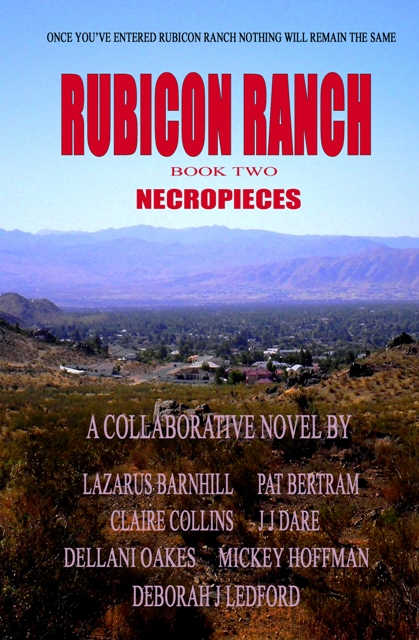
Rubicon Ranch: Necropieces -- The Story Continues

Rubicon Ranch is a collaborative and innovative crime serial set in the desert community of Rubicon Ranch and is being written online by the authors of Second Wind Publishing. Seven authors, including me, are involved in the current story — Rubicon Ranch: Necropieces.
 
Residents of Rubicon Ranch are finding body parts scattered all over the desert. Who was the victim and why did someone want him so very dead? Everyone in this upscale housing development is hiding something. Everyone has an agenda. Everyone’s life will be different after they have encountered the Rubicon. Rubicon Ranch, that is.

Although some of the characters were introduced in Rubicon Ranch: Riley’s Story, a previous collaboration, Rubicon Ranch: Necropieces is a stand-alone novel. A new chapter is posted every Monday.

We hope you will enjoy seeing the story develop as we write it. Whodunit? No one knows, not even the writers, and we won’t know until the very end!

Chapter 25: Melanie Gray
by Pat Bertram

Melanie paced her rented house, wandering through the great room to the bedroom, then up the stairs to her loft office to stare out the window. The clouds that had skirted Rubicon Ranch all day yesterday had settled over the town in the early morning hours. The rainstorm had now weakened to a soft drizzle, but floodwaters were swirling out of the desert and down the middle of the street like dirty bath water in search of a drain.

Melanie half expected to see body parts floating by, but it had been forty-eight hours since she had found the ravens breakfasting on the disembodied foot, so perhaps by now all the necropieces had been discovered. Shivering, she turned from the window, trudged down the steps to the great room and then into the bedroom. She’d spent most of the fifteen weeks since Alexander’s death roaming the desert, and she found it almost impossible to relax during this enforced incarceration. If she were any kind of photographer instead of an amateur shutterbug, she’d be out in the desert despite the rain, chronicling the way the runoff was recreating the desert floor, but her tiny camera wouldn’t stand up to the moisture, and then where would she be?

She plodded back through the great room and up the stairs again. Her cell phone rang, and for just a second, her spirits rose. Alexander! He was finally calling to tell her he was coming back. Just as abruptly, the realization that he was dead hit her like a physical blow, and tears spilled down her cheeks. Why couldn’t she remember that he would never come home? His body had been cremated and the ashes stored in a square brass urn sitting atop the dresser until she could take them high up into the Rocky Mountains in Colorado and scatter them.

By the time she reached her bedroom where she’d left her cell phone on the nightstand, the phone had stopped ringing. The tiny screen showed the number for her agent, and when the phone rang again, she considered not answering. What could the woman say that hadn’t been said a dozen times before? Melanie already knew her deadline had passed. She already knew she owed the publisher either the book or the return of the advance. She already knew . . . Oh, crap. It would be better to talk to Dottie and get it over with.

“Yes?” she said, hating the hesitancy she heard in her voice.

“Dahling!” Dottie chirped. “I’ve been calling and calling. Have I got good news for you! I’ve been talking to Jack, and he says you can have all the time you need to finish the desert book. He’ll even hire a photographer for you. And he’ll send you five hundred thousand dollars, though I’m sure I can get him up to a million.”

“What does he want from me? A kidney?” Jack Nolan, her publisher, had a reputation for wringing every last bit of creative effort from his authors while paying the least possible advance. He got away with it because, despite his miserly ways, he was scrupulously honest, remitting every penny of the royalties his authors earned.

Dottie chuckled. “So cynical, dahling. It’s perfect, really. You’re there. You know the people and the place. And from what I understand, you live next door to the Sinclairs.”

“No,” Melanie said, without a hint of uncertainty in her tone.

“You don’t live next door to them? My sources—”

“I mean, no. I will not write whatever book Jack wants me to write. I’m going to finish the desert book and then . . .”

“And then what? Knowing Alexander, he probably left you not only broke but also in debt. Someone is going to write the book about Morris Sinclair. It might as well be you.”

“Wait a minute,” Melanie said. “How do you know what’s going on here?”

Dottie laughed. “The whole world knows. It’s everywhere. On television, Facebook, Twitter. It’s such a delicious story. The author of the infamous ‘Necropieces’ series has himself become a series of necropieces. His fans don’t believe he’s permanently dead. They are holding vigils, waiting for him to come back to life. And his head was found in the house where that little girl died. Riley? Is that her name? The girl that was kidnapped as an infant and then killed by her biological father? How can you not want to write the story of Rubicon Ranch? It’s going to be huge. Humongous.”

“Not interested.”

“Wait! There’s more!” Dottie said. “You gotta love this stuff. One of the suspects in Morris’s murder is Tara Windsor.”

“Who?” Melanie asked.

“You had to be living out in the boonies somewhere not to have heard of Tara. Oh, right—you’ve been out of the country for the past umpteen years. Tara is an actress. She was in that movie with that actor, you know, the one with the gorgeous abs? No, I guess you don’t know. Anyway, it turns out the suspect isn’t Tara at all. Tara is in Cabo with her pool boy. Don’t you just love it?”

Melanie sank down onto the bed, suddenly weary. “No.”

“And then there’s you,” Dottie said slyly.

Melanie sat up straight. “Me? What about me?”

“The cops say you’re a suspect. You knew that, right? Jack says if you killed Morris and tell all the gory details, he’ll up your advance to two million.”

A suspect. Melanie had presumed the Sheriff’s insinuation that he considered her a suspect was his way of manipulating her and keeping her off balance, but if he or someone in the Sheriff’s department had given out her name, then she really had a problem. She heard the echo of herself screaming at Morris, “You leave me alone, Sinclair, or I’ll be shooting your dead body parts.” Could she have been more foolish?

“Do you know a good lawyer?” She gave a small laugh, wanting Dottie to think the question a joke, but fear clutched at her belly with clammy fingers. Maybe she’d have to write Morris’s story in order to pay for a defense attorney.

“You might not be a celebrity on a par with Morris or Tara,” Dottie said, “but you and Alexander have quite a following. Since there’s been mention of your involvement in Alexander’s death—”

“Who told you I was involved in Alexander’s death?” Melanie demanded.

“Just a guess.” Dottie voice sounded smug, as if she’d caught Melanie out in a secret. But there was no secret when it came to Alexander’s death. Just shoddy police work. “So many important deaths in such a small place make for a good story,” Dottie added.

“All the deaths are unrelated,” Melanie pointed out.

“Perhaps, but it’s more likely they are connected somehow. After all, Morris had autopsy photos of that little girl, and Alexander took some photos of necropieces for Morris.”

“You knew about that?”

“Alexander accidentally included a couple of the pictures when he sent Jack a batch of desert photos.”

Melanie sighed. “Maybe you’re right. Maybe Alexander’s death had something to do with Morris and the evil that this place seems to bring out in people.”

“So can I tell Jack you’ll write the book if he gives you an advance of a million dollars?”

“No. But you can tell him I’ll consider it.”

“Good girl. I’ll see what I can do about finding you a lawyer.”

Melanie set the phone on the nightstand, and put her head in her hands. Oh, Alexander. Look what you’ve done to me. She took a few deep breaths, determined not to cry, but when the tears spilled over anyway, she jumped to her feet, ran up the stairs, and plopped in front of the computer. Immersing herself in research always helped take her mind off herself, and she needed to know more about Morris before she could give Dottie her decision.

Typing “Morris Sinclair” into her search engine resulted in over two hundred million hits. Morris’s website. Book and movie sites. Thousands of fan sites and cult groups. Blogs. Articles. She narrowed her search to “Morris Sinclair biography” and managed to piece together the story of a highly narcissistic and anti-social man in his late sixties who had started out as a normal kid, turned into a troubled and rebellious teenager, and grew into a sadistic beast during his tour of duty in Vietnam.

After Vietnam, Morris married a woman he’d only known for a few weeks. He worked as a roughneck on an oilrig and wrote tales of terror on the side. When the stories were published, they found an immediate readership. He quit work to write fulltime.

Morris and his wife had three children, two boys and a girl. His wife committed suicide while the children were very young. Or perhaps Morris had killed her? That made more sense to Melanie—what mother would kill herself and leave her children to be raised by the devil incarnate?

Although the thought of a million dollars and the freedom it could buy tempted her, Melanie did not want to spend the next few months of her life immersed in the evil that was Morris. She was all set to call her agent and turn down the deal, when the doorbell rang.

She opened the door to find Lieutenant Frio and Deputy Midget standing on her doorstep, their faces set as if in stone.

“Ms. Gray,” Lieutenant Frio said, “we’d like for you to come with us. Sheriff Bryan wants to talk to you.”

Melanie held out her hands, wrists together, but Deputy Midget shook his head. “Sheriff Bryan says not to cuff you unless you give us trouble.”

“Can I get my coat?”

Lieutenant Frio threw Melanie a stern look. “You’re not going to try anything?”

“No.” Melanie darted into the bedroom, grabbed a trench coat from the closet and tucked her phone in the pocket.

Sandwiched between the two law officers, Melanie marched out to the tan Navigator parked at the curb in front of her house. Deputy Midget opened the back door of the vehicle, put a hand on her head to guide her through the opening as if she were a common criminal, then lowered himself into the front passenger seat. The right side of the Navigator sank, and the tires seemed to scream out for relief.

Lieutenant Frio peeled away from the curb. The tires sent up huge plumes of floodwaters that broke over the vehicle, and made it seem as if they were driving through a car wash.

Melanie stared out the window, though she couldn’t see anything but the backwash of water. If she strained her ears, she felt sure she could hear Alexander’s ghostly laughter. During all their years of living in countries with no civil liberties, they had never had a single problem with the authorities, and yet now, not even four months after his death, she found herself at odds with the law.

Maybe this arrest was just another of the sheriff’s games? She had never known what he wanted from her, though when they met after she’d found Riley’s body, he had focused his attention on her, and made her feel . . . seen. No one but Alexander had ever looked at her that closely, and even Alexander had stopped paying attention to her years before. Or maybe what had seemed like manipulation—the sheriff concentrating his attention on her and then ignoring her—had all been in her head, a widow’s cry to be noticed.

Once they hit the dry road of the highway, the thirty miles to Rojo Duro seemed to slip past in an instant. Deputy Midget ushered Melanie to a small room with two chairs and a metal table bolted to the floor, and left her alone.

A mirror on one wall had to be a one-way window, but Melanie put a finger against the glass to be sure. Finger touching finger without any space told her the truth—anyone could be watching her from the other side, and she would never know. She resisted the urge to stick out her tongue in a childish show of temper. Instead, she sat tall in a chair, hands folded on the table, and tried not to think of where she was. Tried not to think of her pathetic life. Tried not to think of her uncertain future.

Nine minutes later, Sheriff Bryan entered the room and locked the door behind him. He perched one hip on the table, and stared at her, no friendliness in his eyes.

After a long moment, he heaved a sigh and said, “Why did you do it, Melanie?”

***

Pat Bertram is the author of the suspense novels Light Bringer, More Deaths Than One, A Spark of Heavenly Fire, and Daughter Am I. Bertram is also the author of Grief: The Great Yearning, “an exquisite book, wrenching to read, and at the same time full of profound truths.” Connect with Pat on Google+

Monday, October 01, 2012

Novel Writing Tips and Techniques From Authors of Second Wind Publishing

Novel Writing Tips and Techniques from Authors of Second Wind Publishing is the 100th book published by Second Wind. I am thrilled to be a part of this extraordinary project.
 
"As someone who constantly evaluates novels for publication, I was astonished at the breadth and clarity of the wonderful advice contained in this handbook. It addresses concerns as grand as plot development and as simple but essential as formatting your submission. It offers crucial advice on literary topics ranging from character development to the description of action. Virtually every subject that is of great concern to publishers — and therefore to authors — is covered in this clear, humorous and enormously useful guide." --Mike Simpson, Chief Editor of Second Wind Publishing

Table of Contents

A Publisher's Top and Bottom Five: What We're Looking For vs. What We're Watching For by Mike Simpson
On Becoming an Author by Susan Surman
Finding Time to Write & Overcoming Writer’s Block by Mairead Walpole
Creating Incredible but Credible Characters by Pat Bertram
How to Begin and End a Story by Lazarus Barnhill
Plot Twists: Three Little Questions by Norm Brown
Points of View by Juliet Waldron
Moving Smoothly: Transitioning in Writing by Jan Linton (JJ Dare)
Captivating Settings by Deborah J Ledford
Foreshadowing by Nancy A Niles
Timing by Claire Collins
Don’t Keep Me Dangling by Sherrie Hansen
Sex SCENES not SEX Scenes by Pat Bertram
Film as Literary Influence on the Novel: How to Approach Scenes by Eric Wasserman
How Much Narrative is Too Much by J. Conrad Guest
A Jerk’s Guide to Comedy Writing by Noah Baird
The Challenges and Joys of Writing a Novel Series by Christine Husom
Creating a Believable Science-Fiction Environment by Dellani Oakes
Write it Right by Dellani Oakes
The Importance of Formatting by Deborah J Ledford
Writing Aids and Organizational Tools by Coco Ihle

Novel Writing Tips and Techniques is available from Second Wind Publishing, Amazon (Print & Kindle), Barnes and Noble (Nook), Smashwords (all ebook formats including palm devices)

Click here to Help Us Celebrate the Publication of Our 100th Book!!

Friday, May 11, 2012

New Release: How I Made Over $42,000 Selling My Kindle eBooks

In March 2012 one Canadian author boldly went where few have gone before—into the land of making real money with Amazon's KDP Select program.

This is her story…

My name is Cheryl Kaye Tardif and I am an international bestselling suspense author who earned over $42,000 dollars in March 2012 selling ebooks via Amazon's KDP Select program, captured the interest of a major literary agency, and went on to sign with a foreign rights agent. And I'm about to tell you HOW I did all that.

I don't normally tell people how much money I make, but I believe writers need to know it IS possible to earn a real income from your books. Seriously, if I can do it, anyone can—if you have the right combination of criteria and techniques.

In this book, I'll share with you what I believe are four key elements you must have in place to see high sales. And I'll reveal the strategic techniques I used during my KDP Select promotions that resulted in earning over $42,000—with $32,000 of that from ONE title alone.

Not only did I earn over $42,000 in ebook sales, I was contacted by one of the leading literary agencies in New York. The chairman noticed my success when my one title made #4 in the Top 100 Bestselling Kindle ebooks, right under The Hunger Games trilogy. Since then, I've signed with another agent for foreign rights.

So, if you're ready to earn some real money with Select, let's begin…

Available at Amazon (Kindle) for only $2.99.

Wednesday, September 29, 2010

Lancelot's Lady and the new book video trailer

Here's the video trailer for Lancelot's Lady, my contemporary romantic suspense novel. The trailer was created by Kelly Komm, author and trailer creator extraordinaire. Thanks, Kelly! You're awesome!


To celebrate the release of Lancelot's Lady, I'm holding my Cherish the Romance Virtual Launch & Book Tour, with daily prizes, including jewelry, signed paperbacks and ebooks from various authors, plus other prizes. Come join the fun from now until October 10th.

Leave a comment here, with email address, to be entered into the prize draws. You're guaranteed to receive at least 1 free ebook just for doing so. Plus you'll be entered to win a Kobo ereader. Winners will be announced after October 10th.

Let me know what you think of Kelly's video trailer. Does it make you want to buy Lancelot's Lady? Or does it make you want to take a trip to the Bahamas. :-)

Cherish D'Angelo
(aka Cheryl Kaye Tardif)

Sunday, July 18, 2010

Should writers pursue print publication or publish their own ebooks?

The above question came up in a forum recently, and while everyone has to determine what's right for them as it is a very personal decision, I gave them my thoughts on the topic.
I say go for both--print and ebooks. If you have a traditional publisher for your print, all the better. But don't let that stop you from publishing your own ebooks, especially the ones your agent and publisher aren't interested in. You definitely don't want to overlook the ebook market. That's where the money is right now for authors, if you publish the ebooks yourself.

As a self-published and traditionally published print author, I've seen the pros and cons to both sides.

If you have a backlist of titles that your publisher is finished with, get them up on Amazon Kindle, KoboBooks and Smashwords right away. Sales of ebooks are on the rise, and they won't be stopping or slowing any time too soon.

Other ideas for ebooks: publish a collection of short stories or an anthology with other authors, publish a novella or novelette, publish a how-to book or a book of poetry.

I have 4 ebooks coming out between April 1, 2010 and Sept 27, 2010. :-) There's only one thing better than promoting your books, and that's writing them!

My agent is holding 2 thrillers. I'm considering taking one back and publishing it as an ebook next spring.

The key is this: you want to build momentum, then try to keep that momentum going. And the only way to do this is to keep releasing books under some semblance of regularity.
With Amazon's recent royalty raise to 70% for qualifying ebooks, it's possible for authors to now make more money selling less expensive ebooks than selling traditionally published print books. But in the end, it depends on the personal goals of each writer.

Cheryl Kaye Tardif,
bestselling author & book marketing coach
http://www.cherylktardif.com

Wednesday, June 09, 2010

Cheryl Kaye Tardif issues a challenge to book pirates

So the great book piracy debate is still churning stomachs over at JA Konrath's blog, especially now that his "experiment" has proven one thing: Joe knows how to sell books. Something I didn't doubt for a minute.

Since his experiment is rather skewed in one direction--for piracy--I thought I'd had my own "control" side. I'm issuing my own "experiment" or challenge to book pirates...if they dare to take the challenge.

Konrath says "steal this book"; Tardif says "please don't steal mine"

Cheryl Kaye Tardif,
bestselling author
http://www.cherylktardif.com/

Friday, May 28, 2010

Top 10 Tips for Editing Your Book


Here is a list of the top 10 tips for editing your book, once you have completed the first draft:
  1. Run the manuscript through your computer's spell check and grammar check. Use spell and grammar check, but DO NOT RELY ON THEM to catch everything. That is NOT the end of your editing. It's only the beginning.
  2. Read your work and edit it, chapter by chapter. Start from the beginning and edit each chapter, looking for issues with plot, characters, continuity, typos, grammar and more. This is your first main edit.
  3. Do a synonym check. Go through the manuscript and look for synonym errors (too/two/to, your/you’re, their/there/they're, rode/road, where/wear, its/it's, etc). If you’re using Microsoft Word, you can use the Find button to help you search for these terms. As you come across synonym errors, make a list for future use of the ones that seem to catch you up most frequently.
  4. Do a tense check. What tense are you writing in? No matter what tense you use, make sure it's consistent throughout the book. “Look especially for tense errors in dialogue tags,” I said. “I will,” she says.
  5. Do a ‘was--ing’ check. 'She was walking down the road...' should be changed to 'She walked down the road...' or 'She strode down the road...' We want the action NOW. There are some exceptions. If something else happens as a result, then you can use ‘was--ing’, such as in ‘She was walking down the road when a car appeared out of nowhere, heading straight for her.’
  6. Format your manuscript like a published book. Copy your file and title it "final edit". Format it so it looks like a book you'd find in a bookstore, one of similar genre. Single spaced. Sized according to trade paperback (5.5 x 8.5 or 6 x 9). 1/4 to 1/2 inch margins. Then print it out. Seeing your work resemble an actual book is the first stage of your final edits. You need to see how it physically looks. After you’ve completed ALL editing, you can reformat the layout and size.
  7. Look at the whitespace/text ratio on the printed copy. Whitespace is where the reader's eyes take a quick break, where they absorb what they've read. Our eyes instinctively search out whitespace. Being able to recognize a good balance is almost an art form. When in doubt, find a book you really enjoyed reading and examine the balance. You want a flowing mix of both whitespace and dark text. Too much whitespace on a page means too much dialogue or one-liners and not enough "meat" or description or information. Too much dark text means many readers will start skimming. Paragraphs should be broken into manageable chunks. Keep individual paragraphs to less than 1/3 of a book page and make them random in length.
  8. Mix up the chapters and edit again. Take out individual chapters at random and edit them without the benefit of the preceding or following chapters. This helps you focus on the actual writing. You can also pull random pages and edit them out of order. This gives you a bit of a break from the story, so you can focus on technical issues.
  9. Read your book aloud. Reading your work aloud, chapter by chapter, helps you focus on the rhythm of your words, not just the words themselves. Think of it like music. A well written book has a natural flow. If you find yourself hesitating, that usually is an indication of a problem area. Mark it with a highlighted dot so you can return to it after you've read the entire chapter. Edit all highlighted areas, then review it (aloud or silently) again.
  10. Find at least 2 editors who know HOW to edit and 2 readers to evaluate your work from a reader’s perspective. Have the editors edit your work, preferably people who know HOW to edit. Professional editors and English teachers/professors/majors are your best choice. Once they’ve gone through your book, really weigh their suggestions. If what they say improves the book, make the changes. The trick is to be able to remove yourself from the personal attachment of your work so you can recognize when someone else’s suggestions will make it better. Sometimes you’ll need to think on their feedback for a day. Once they’ve given you their feedback, make changes and go through the manuscript one final time.
If you’ve done all of the above, your work should be quite polished by this point. There are, of course, numerous things to watch for when editing a book, but this tip list will at least point you in the right direction and get you off to a good start. While editing is work, it can also be inspiring. This is the time when you see your work pulling together into a creation that will be more marketable and more acceptable. There are no shortcuts with editing. Not if you want a career in writing books. Happy editing!

**************

Cheryl Kaye Tardif is a bestselling suspense author and book marketing coach living in Edmonton, Alberta, Canada. She has been featured on TV, radio, in newspapers and magazines. Cheryl has presented at writers' conferences on the topics of book marketing. Her next release is Lancelot's Lady, her debut romantic suspense written under the pen name of Cherish D'Angelo. http://www.cherylktardif.com/

Sunday, May 09, 2010

Climbing Mount Momentum


Becoming a successful, money-making author is like being a mountain climber. You can't fulfil your big dream or goals without a lot of hard work, sweat, and a plan of attack, but once the momentum starts rolling, the climb becomes easier as long as you take it one step at a time. The successful, money-making author and the mountain climber must first prepare themselves, and they have similar checklists.

Mount Momentum Checklist:
  1. You have to assess your goals. What do you want to achieve? You want to make it to the top, of course. How will you get there? How long will it take?
  2. Scope out the landscape. What are others like you doing? How are they making it to the top? Can you duplicate this? How hard will it be? What are you prepared to sacrifice to get there?
  3. Practice on smaller mountains. Don't just rush up the biggest mountain you can find. Practice on some smaller hills first. Practice makes perfect--or at least it'll help keep you alive. Practice with a safety net or harness. Don't quit your day job to go running off to that mountain. Use others for support too.
  4. Accumulate the right gear and tools. You wouldn't try climbing Mount Momentum with stilettos and a pair of driving gloves, would you? If you answered 'yes', please go to the next post in this blog. If you answered 'I'm not that stupid', keep reading. Make sure you have the right tools, the stuff that'll make your goal much easier to reach. Be prepared. Sometimes this step can take a while. But that's better than slipping and falling off the mountain, isn't it?
  5. Invest a huge amount of physical energy. Once you've taken that first step up that mountain, be prepared to become exhausted. This is draining work. You're trying to haul your butt up to the top of a peak you can only imagine, unless you've been there before. Your body is going to hurt. Your mind is going to hurt. Take frequent pauses along the way, but don't stop too long. Keep your eye on the prize.
  6. Maintain a bulldog-like persistence. Keep your eye on the prize. Yes, I know I just said that, but it bears repeating. Go after what you want with all you've got. Don't stop until you get to the top. If you lose your grip and slide down a bit, take a breath, reconsider where you're at and where you want to be, then start climbing again.
  7. Climb with a friend. Use the buddy system for safety and encouragement. Pair up with someone who has the same goals. Arrange joint climbing ventures. Learn from each other. Support each other and cheer each other on. And if one of you falls, make sure the other is there to catch. Or at least make sure he falls first so you can land on him (ok, joking).
  8. Re-evaluate your goals. If you fall off Mount Momentum completely, it'll suck. You have to start all over again. First, make sure you really want to get to the top. Maybe you could do some other kind of extreme sport--like kayaking or ping-pong. Maybe that damned mountain just isn't all that important. But if it's still your deepest desire to get to the top, pack on your climbing gear and get moving. The longer you sit on your butt, the faster the momentum disappears. Until one day it's just a dream again.
  9. Pray to the Universe for a streak of luck. All it takes is one misplaced foot, one wrong slip, one faulty piece of equipment, or one giant thunderstorm to set you back. Luck plays an important role in your success as a successful, money-making, author mountain climber. Without luck, you're dead in the water--even though this is a mountain analogy. Without luck, you wouldn't even be in the position to consider climbing that freakin' mountain.
Now go out and conquer Mount Momentum, before you lose your courage--or your place in line.

Cheryl Kaye Tardif,
author of Whale Song, The River and Divine Intervention
http://www.cherylktardif.com

Thursday, March 25, 2010

Understanding the myths regarding self-publishing versus traditionally publishing

There are a lot of myths and misconceptions out there regarding the pros and cons of either self-publishing or traditional publishing. I recently came across a blog that was advising writers on 5 Reasons to Self-Publish Your Next Book, and I found all but one of the 5 points to be very misleading. Of course, this is my opinion, based on the fact that I know a lot of authors who have done either or both, and I have done both.

Without printing the author's explanations, here are the 5 reasons the author offered, and my opinion on them.

Reason #1: Self-Publishing is Not Nearly as Difficult As You Think
Reason #2: Publishing Companies Don’t Actually Do Anything.
Reason #3: You Will Make More Money.
Reason #4: You Will Spend Less Money.
Reason #5: A Publisher Will Never Care As Much As You Do.

While I heartily agree with #1, I find the rest of the points quite misleading, especially to newer, less experienced writers. As an author who has both self-published and published traditionally, I am not speaking from one bias. There are definite pros and cons to both sides and I am pro-self-pub and pro-trad-pub.

Allow me to clarify...

#2: Publishing Companies Don’t Actually Do Anything: 
This is untrue for the most part. Publishers do a LOT for their authors; much of it is behind the scenes stuff that authors never have to worry about, such as sending copies to Library of Congress, obtaining and registering ISBNs, obtaining UPC and other codes, finding good editors, finding great cover designers, aligning with a solid distributor so your books get to bookstores and events on time, preparing review lists and packages to entice advance reviewers to read your book, sending out ARCs (advance reading (or review) copies), and so many other tasks BEFORE your book is ready to sell. Of course, self-pub'd authors CAN do these things themselves, but it'll cost time, money and they may not have the connections needed.  

When the book launches, many publishers will assist with book tours and launches (some financially, some with setup), they often pay for co-ops in bookstores (endcaps or special bins that get more notice and advertising), represent the author at book fairs like BEA and the former BEC and more, print brochures and mail out to libraries, schools, bookstores and other book retailers.  

I'm not saying that every traditional publisher does all of this. But a reputable and good one will do much of this. I have heard this from MANY of my traditionally published author friends. 

#3: You Will Make More Money: 
This is very misleading. When you self-pub a book, you WILL make more money per copy--providing you sell them all and AFTER you've paid for them. But the average s/pub'd author prints short runs, anywhere from 200-1000 books on average. S/pub'd authors who write non-fiction and have a strong platform and venues like colleges or organizations to sell their books to will generally print larger runs. These are the s/pub'd authors who tend to make more money. But they also spend more in traveling expenses.  

The average self-pub'd fiction author will make more per copy but sell far fewer copies than they would if they were traditionally published. I know this from experience and from my fellow authors who have shared their stories. I self-pub'd Whale Song in 2003. It was quite successful and I made back my initial investment (subsidized costs and print costs) very quickly. In the first 3 years I made a fair amount of money. In 2007, Whale Song was published by a trad. publisher. A larger print run was printed (one I didn't have to pay for) and the distributor got my books into more libraries and stores than I had on my own. In the first 2 years, I sold more copies because of distribution and advertising that my publisher did. I made MORE money this way.  

#4: You Will Spend Less Money: 
After reviewing my income tax forms, I can safely say that I spent very close to the same amount with each method I used. When I self-published I had a lot of start-up expenses and printing costs. When I was traditionally published, I had other expenses, like sending out review copies to anyone I wanted to (not including the major reviewers that my publisher took care of). My promotion costs in both cases were nearly the same. However, I spent more on my book launch for my last self-pub'd book than I did for the trad. published one. No matter if you're self-pub'd or trad pub'd there are opportunities out there that will cost money or save you money. (I'm a book marketing coach, and I coach authors about promotion.)  

#5: A Publisher Will Never Care As Much As You Do: 
This statement is both correct and incorrect, in my opinion. You, the author, will care more about your creation as a whole, because you thought it up, slaved over it, perfected it, struggled with it, loved it/hated it, etc. You WANT success so badly that you see your work as a pedway to the top.  

However, a publisher cares too. They see your work as an INVESTMENT. They've purchased the rights, taken a huge leap of faith on it and YOU, they've risked their finances, time and reputation on you and your work. Of course they care. But yes, for different reasons (for the most part) than you, the author. Although, I have heard that there are still some publishers out there who genuinely care about their authors, the books and everyone's success.  

#1: Self-Publishing is Not Nearly as Difficult As You Think: 
This statement is absolutely correct. Nowadays, self-publishing is as easy as a good printer and binding equipment. That doesn't mean the work itself is any good--or the editing. I advise my clients who are considering self-publishing to ensure that their work meets the same high standards of trad. pub'd books. Yes, even a bestseller can have typos, but on average they are better edited. If you self-pub, hire an editor. If you aren't artistically talented, pay for an eye-catching book cover design, not some cheesy looking cut and paste design a ten-year-old could make. You can self-pub completely on your own (I call this DIY self-publishing) or with the assistance of a subsidy publisher (they often have great distribution set in place to get you up and selling much faster than DIY) and some subsidies offer decent editing.  

Regardless of how you publish, make sure you check the publisher (printer, distributor, editor) out very carefully. Contact some of their past and present authors and ask how their experiences were. Check them out on Preditors and Editors and Absolute Write. Above all, be informed about all the pros and cons.  

Happy writing, publishing and promoting!  

Cheryl Kaye Tardif, 
bestselling author & book marketing coach 
http://www.cherylktardif.com  
http://www.shamelessbookpromoter.com

Thursday, October 29, 2009

The business side of being a writer


Some people might not view an author as a business person, but I have to tell you, there's far more to being a writer than cloistering oneself in a small room for months and typing out 80,000 words. In today's world, a successful writer must also take on the hats of publicist, marketer, event planner, advertising rep, accountant, stocker (not stalker) and more.

As a successful Edmonton author, I am right at home with the writing and marketing part. I even make a decent publicist and have done this for other writers. It's the accounting part I suck at. And the stocking of shelves.

I'd love to discuss this here with other writers. How do you manage the number side of writing? Do you hire someone else or just suck it up and do it? Are there other options you've discovered (other than having books published by a traditional publisher, which I've also had)?

For me writing is both an immense pleasure and a business. I can't really have one without the other--unless I want to be my only reader. With the economy being as it is and so many changes in the book industry, authors must take on more of the marketing role, no matter who publishes you.

Finally, a small bit of promo from the marketing side: I am one of only a handful of Canadians who are competing in a writing competition sponsored by Dorchester Publishing, a very respectable US publisher. I think I'm the only Edmonton contestant as well. I'd sincerely appreciate your support.

Please check out my debut romantic suspense Lancelot's Lady on Textnovel.com and click on the blue thumb and blue phone circles. This gives me 2 points in the contest. There are 3 days to go until the semi-finalists are selected. I really want to win this! The prize is a publishing contract with Dorchester.

http://textnovel.com/stories_list_detail.php?story_id=928

Sign up is fast and free and you'll have access to many novels and short stories you can read for free. Thank you, in advance, for your support of an Edmonton author.

Now I must go and procrastinate about doing my accounting. :-)

Cheryl Kaye Tardif
http://www.cherylktardif.com

Thursday, October 08, 2009

HOW DO YOU CHOOSE THE BOOKS YOU WANT TO READ?

I took an informal poll to find out how people discover new authors. I posted the following on discussion boards on both Goodreads and Facebook:

It seems as if there are as many ways of discovering books as there are readers, but I'm curious as to how you choose the books you want to read. Do you go by reviews? By recommendations from friends? Because you're familiar with other works by the author? Do you ever read a book because of an ad you saw? Because of a blog article? Because of a mention on a website such as Goodreads? Do you cruise book stores, libraries, or online sites like Amazon? Do you find them some way I haven't mentioned, such as gifts, perhaps?

Admittedly, the questions were loaded, but I still got an interesting and probably quite accurate overview:

Favorite authors/previously read authors: 36
Word of mouth: 26
Blog reviews/Book websites: 26Goodreads/Shelfari: 24
Local bookstores: 21
Amazon/B&N/other online stores: 15
Library: 13
Publisher sites/newsletters: 5
Social networking sites like Facebook: 5
Book Clubs: 5
Author appearances/writing conferences: 5
NY Times bestseller list: 5
Offline reviews: 5
Yard sales/second hand bookstores: 4
Advertising: 3Saw the movie: 3
Oprah: 1
Free downloads: 1
Gifts: 1

So, how do you discover the books you want to read? Or rather where. (A lot of people said they found books to read by the front cover or the blurb on the back, but I’m more curious as to where they saw the cover.)


Daughter Am I, a young woman/old gangsters coming of age adventure will be published next week by Second Wind Publishing.

Thursday, July 30, 2009

Will a publisher do the book marketing for me?

I often receive emails from aspiring authors who want to know if they can find a publisher who will do all their marketing (or most of it) for them. Sometimes the author isn't confident they can promote their book; sometimes it's a matter of the author having no money to invest in their marketing endeavors. Getting a book published is only half the battle, and authors need to recognize that and prepare for the other half--marketing their books.

In my experience, and from everything I've read and heard from publishers, agents and other authors, there is no such 'free' ride. Authors must be willing to promote their books if they want them to sell. Publishers nowadays only want to take a risk on new authors who are enthused about marketing their books. In fact, they often ask you upfront, before they sign you, what your marketing plans are. And you have to have some. It's that simple.

Most publishers do little marketing beyond their initial catalogues, industry notices, ads in magazines or newspapers--unless you're a big-name author. It's really up to authors to get the word out. Your publisher might print some promotional material for you--posters, bookmarks or business cards. Most authors pay for their own expenses during book tours, including travel, lodging and meals. The distributors have sales teams who go into bookstores to try to sell books to the store owner/manager. Sales teams often don't do much for authors who don't promote their books. Why should they when they have other authors out there busting their butts to sell books? :-)

An author in today's world--who wants to be successful and actually make some money back to pay for their marketing endeavors--must be proactive.

The five musts that every author should have:

  1. a professional author's site with domain name and no free hosting
  2. a blog that's updated at least once a week
  3. Facebook account and knowledge in how to use it properly
  4. MySpace account and knowledge in how to use it properly
  5. Twitter account and knowledge in how to use it properly
Those are the basics in today's marketing. Nothing is free. It takes hard, dedicated persistence to make a book successful. The meaning of success can vary from person to person. I look at success in two levels--basic level: lots of readers who love the book and enough sales to pay for the $5000+ it costs to market a book efficiently; and advanced level of success: major traditional publishing contracts, great distribution, and major bestselling status, which all equals money I could live on.

What I've described above is the real world of publishing. It's a tough industry to break into because the competition is HUGE! You're competing against billions of authors. If you want your book to sell and be successful, you have to be part of the marketing--a huge part.

~Cheryl Kaye Tardif,
bestselling author & book marketing coach
http://www.shamelessbookpromoter.com
http://www.cherylktardif.com