I asked my husband, a retired English teacher, for a subject for today's post, and he complained that people today, generally, read a lot of non-fiction, but don't take fiction seriously.
Fiction, he said, can offer a distilled truth that non-fiction can't.
I find that insightful and possibly the highest strength of good fiction.
He mentioned, in particular, Dickens writing about the plight of the poor in Victorian England. The facts were available, but Dickens took his readers into the lives of the poor. When we read about Little Dorrit, Oliver Twist, or even Fagin, we experience their suffering; we see the prejudices and systemic abuses from their sides.
We can read histories of times and places and know the facts, but a rich fiction can put us there inside a participant.
As he also pointed out, fiction can also harden stereotypes and perpetuate mythologies, but I maintain that only poor fiction does that. Good fiction doesn't deal in stereotypes, but in individuals, who do things that may look stereotypical for true, personal reasons; if they don't, it isn't good fiction.
What do you think?
Marian Allen, Author Lady
Fantasies, mysteries, comedies, recipes

Showing posts with label fiction. Show all posts
Showing posts with label fiction. Show all posts
Thursday, March 21, 2019


Wednesday, July 24, 2013
Interview with Marian Allen, Author of the Sage Books
 What is your book about?
The SAGE trilogy is about a land thrown out of balance by the selfishness of its ruler. When the most selfish of the Four Divine Animals (Tortoise) decides to stir things up and use a few chosen people to make even more of a mess, events take unexpected turns.
Who is your most unusual/most likeable character?
The most unusual character in SAGE has to be Tortoise. Sometimes he appears as a tortoise, sometimes as a man, sometimes as a cat, and sometimes as The Black Warrior, a terrifying sight on the battlefield. He can probably appear as a woman, too, but I haven’t written that story yet. As his author, I like him very much, because he was so much fun to write, but I can’t say he’s a likeable character. ~grin~
How long did it take you to write your book?
SAGE took me close to 20 years, from first glimmer to print/eBook. I kept getting agents who loved the book but wanted changes, then didn’t like their own changes or didn’t want to wait for my rewrite. I rewrote the book, start to finish, three or four times, by which time I had gutted it of most of its strangeness. My youngest daughter, who had grown up listening to the rewrites, told me to stop listening to what other people thought and trust myself. I did one more rewrite, making it exactly what I wanted it to be, and that’s the one I sold to Hydra Publications.
How much of a story do you have in mind before you start writing it?
Often it’s just a glimmer. Maybe a setting, a character, a situation, or a line of dialog. I start writing – I call it writing my way into a story – and stop to do some plotting and planning before I go on. Very rarely do I have the whole thing in mind before I start that initial writing.
Did you do any research for the book? If so, how did you do it? (searching Internet, magazines, other books, etc.)
I did a lot of research for SAGE. I read books on unicorns, on animal symbology and mythology, on English Anglo-Saxon life, and on the history of castles. Oh, and historical food and clothing. And silversmithing. One thing that really gets my goat is people who say, “It must be nice to write fantasy. You don’t have to do any research!” ~laughing~
What about your book might pique the reader’s interest?
There isn’t any swashbuckling or great feats of sorcery in SAGE, although swords are wielded and magic is present. One character says having magic is like being aware of another reality that’s as real as the one everybody else is aware of as well as being aware of everybody’s reality at the same time. I think readers will be intrigued by this feeling of the ordinary/extraordinary duality.
How do you develop and differentiate your characters?
I ask my characters questions. After the rough draft, I fill out character sheets on them, including asking them 10 random questions and letting them answer in their own voices. I find their voices become much more individual and strong as the questions proceed. Then I can do the rewrite with those voices in my head and those answers in the background.
Do you have mental list or a computer file or a spiral notebook with the ideas for or outlines of stories that you have not written but intend to one day?
I have a spiral notebook with pocket dividers filled with “bits”. For the first time this year, I did the Story A Day in May challenge, and mined that binder for all it was worth! I still have masses of material in there, though. It’s very reassuring.
What writer influenced you the most?
On the grounds that I should go back as far as possible, I have to say that Walter R. Brooks, creator of the FREDDY THE PIG detective books for kids, influenced me most. Brooks’ characters were individuals with unique points of view and different voices and strong motivations. He knew when to show and when to tell, when to telescope and when to detail, and his bit characters were as unique and memorable as the main ones, and sometimes turned up in later books. Plus, he was funny!
Who gave you the best writing advice you ever received and what was it?
The late mystery writer Dick Stodghill said, “Don’t take yourself too seriously – but DO take your work seriously. Insist that everyone around you take your work seriously. It isn’t some little thing you do, it isn’t a joke, it’s your work.”
Have you written any other books?

Oh, dear me, yes, thank you for asking. FORCE OF HABIT is a cop/sf/farce set on the planet Llannonn, where courtesy is mandated by law and loud-mouthed aliens from outer space – from the planet Earth, to be specific – are sure to find themselves in trouble. SIDESHOW IN THE CENTER RING is another science fiction novel, this one set on the planet Marner, where slavery is legal, and a tourist from Earth reluctantly puts more than her career on the line for someone she doesn’t even like. I’ve collected some of my short stories and self-published them for Kindle and at Smashwords.
Where can people learn more about your books?
The best place to go is my website: http://MarianAllen.com. I have excerpts of all the novels and all the short stories there, as well as a page of links to stories that are free at my site or at other sites on the web.
The SAGE books are available:
The Fall of Onagros
Kindle http://bookshow.me/B00AYF6546
Print http://bookshow.me/0615774474
Bargain With Fate
Kindle http://bookShow.me/B00CLUUO9O
Print http://bookshow.me/0615818323
Silver and Iron
Kindle http://bookshow.me/B00D2GKXGK
Print http://bookshow.me/0615818315
Monday, February 04, 2013
Rubicon Ranch: Necropieces -- The Story Continues
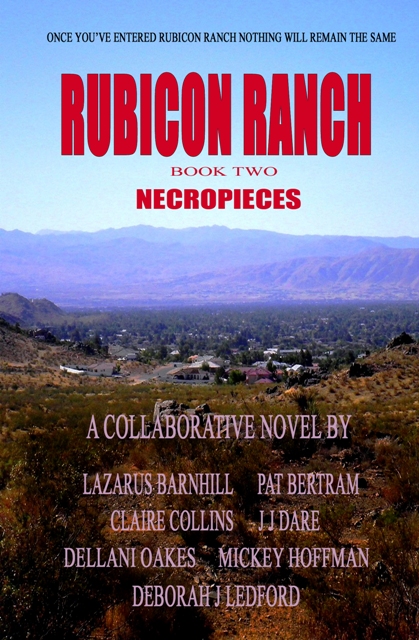 Rubicon Ranch is a collaborative and innovative crime serial set in the desert community of Rubicon Ranch and is being written online by the authors of Second Wind Publishing. Seven authors, including me, are involved in the current story — Rubicon Ranch: Necropieces.
Residents of
Rubicon Ranch are finding body parts scattered all over the desert. Who was the
victim and why did someone want him so very dead? Everyone in this upscale
housing development is hiding something. Everyone has an agenda. Everyone’s
life will be different after they have encountered the Rubicon. Rubicon Ranch,
that is.
Although
some of the characters were introduced in Rubicon
Ranch: Riley’s Story, a previous collaboration, Rubicon Ranch:
Necropieces is a stand-alone novel. A new chapter is posted every Monday.
We hope you
will enjoy seeing the story develop as we write it. Whodunit? No one knows, not
even the writers, and we won’t know until the very end!
Chapter
25: Melanie Gray
by Pat Bertram
by Pat Bertram
Melanie
paced her rented house, wandering through the great room to the bedroom, then
up the stairs to her loft office to stare out the window. The clouds that had
skirted Rubicon Ranch all day yesterday had settled over the town in the early
morning hours. The rainstorm had now weakened to a soft drizzle, but
floodwaters were swirling out of the desert and down the middle of the street
like dirty bath water in search of a drain.
Melanie half
expected to see body parts floating by, but it had been forty-eight hours since
she had found the ravens breakfasting on the disembodied foot, so perhaps by
now all the necropieces had been discovered. Shivering, she turned from the
window, trudged down the steps to the great room and then into the bedroom.
She’d spent most of the fifteen weeks since Alexander’s death roaming the
desert, and she found it almost impossible to relax during this enforced
incarceration. If she were any kind of photographer instead of an amateur
shutterbug, she’d be out in the desert despite the rain, chronicling the way
the runoff was recreating the desert floor, but her tiny camera wouldn’t stand
up to the moisture, and then where would she be?
She plodded
back through the great room and up the stairs again. Her cell phone rang, and
for just a second, her spirits rose. Alexander! He was finally calling
to tell her he was coming back. Just as abruptly, the realization that he was
dead hit her like a physical blow, and tears spilled down her cheeks. Why
couldn’t she remember that he would never come home? His body had been cremated
and the ashes stored in a square brass urn sitting atop the dresser until she
could take them high up into the Rocky Mountains in Colorado and scatter them.
By the time
she reached her bedroom where she’d left her cell phone on the nightstand, the
phone had stopped ringing. The tiny screen showed the number for her agent, and
when the phone rang again, she considered not answering. What could the woman
say that hadn’t been said a dozen times before? Melanie already knew her
deadline had passed. She already knew she owed the publisher either the book or
the return of the advance. She already knew . . . Oh, crap. It would be better
to talk to Dottie and get it over with.
“Yes?” she
said, hating the hesitancy she heard in her voice.
“Dahling!”
Dottie chirped. “I’ve been calling and calling. Have I got good news for you!
I’ve been talking to Jack, and he says you can have all the time you need to
finish the desert book. He’ll even hire a photographer for you. And
he’ll send you five hundred thousand dollars, though I’m sure I can get him up
to a million.”
“What does
he want from me? A kidney?” Jack Nolan, her publisher, had a reputation for
wringing every last bit of creative effort from his authors while paying the
least possible advance. He got away with it because, despite his miserly ways,
he was scrupulously honest, remitting every penny of the royalties his authors
earned.
Dottie
chuckled. “So cynical, dahling. It’s perfect, really. You’re there. You know
the people and the place. And from what I understand, you live next door to the
Sinclairs.”
“No,”
Melanie said, without a hint of uncertainty in her tone.
“You don’t
live next door to them? My sources—”
“I mean, no.
I will not write whatever book Jack wants me to write. I’m going to finish the
desert book and then . . .”
“And then
what? Knowing Alexander, he probably left you not only broke but also in debt.
Someone is going to write the book about Morris Sinclair. It might as well be
you.”
“Wait a
minute,” Melanie said. “How do you know what’s going on here?”
Dottie
laughed. “The whole world knows. It’s everywhere. On television, Facebook,
Twitter. It’s such a delicious story. The author of the infamous ‘Necropieces’
series has himself become a series of necropieces. His fans don’t believe he’s
permanently dead. They are holding vigils, waiting for him to come back to
life. And his head was found in the house where that little girl died. Riley?
Is that her name? The girl that was kidnapped as an infant and then killed by
her biological father? How can you not want to write the story of Rubicon
Ranch? It’s going to be huge. Humongous.”
“Not
interested.”
“Wait!
There’s more!” Dottie said. “You gotta love this stuff. One of the suspects in
Morris’s murder is Tara Windsor.”
“Who?”
Melanie asked.
“You had to
be living out in the boonies somewhere not to have heard of Tara. Oh,
right—you’ve been out of the country for the past umpteen years. Tara is an
actress. She was in that movie with that actor, you know, the one with the
gorgeous abs? No, I guess you don’t know. Anyway, it turns out the suspect
isn’t Tara at all. Tara is in Cabo with her pool boy. Don’t you just love it?”
Melanie sank
down onto the bed, suddenly weary. “No.”
“And then
there’s you,” Dottie said slyly.
Melanie sat
up straight. “Me? What about me?”
“The cops
say you’re a suspect. You knew that, right? Jack says if you killed Morris and
tell all the gory details, he’ll up your advance to two million.”
A
suspect. Melanie had presumed the Sheriff’s insinuation that he considered
her a suspect was his way of manipulating her and keeping her off balance, but
if he or someone in the Sheriff’s department had given out her name, then she
really had a problem. She heard the echo of herself screaming at Morris, “You
leave me alone, Sinclair, or I’ll be shooting your dead body parts.” Could
she have been more foolish?
“Do you know
a good lawyer?” She gave a small laugh, wanting Dottie to think the question a
joke, but fear clutched at her belly with clammy fingers. Maybe she’d have to
write Morris’s story in order to pay for a defense attorney.
“You might
not be a celebrity on a par with Morris or Tara,” Dottie said, “but you and
Alexander have quite a following. Since there’s been mention of your
involvement in Alexander’s death—”
“Who told
you I was involved in Alexander’s death?” Melanie demanded.
“Just a
guess.” Dottie voice sounded smug, as if she’d caught Melanie out in a secret.
But there was no secret when it came to Alexander’s death. Just shoddy police
work. “So many important deaths in such a small place make for a good story,”
Dottie added.
“All the
deaths are unrelated,” Melanie pointed out.
“Perhaps,
but it’s more likely they are connected somehow. After all, Morris had autopsy
photos of that little girl, and Alexander took some photos of necropieces for
Morris.”
“You knew
about that?”
“Alexander
accidentally included a couple of the pictures when he sent Jack a batch of
desert photos.”
Melanie
sighed. “Maybe you’re right. Maybe Alexander’s death had something to do with
Morris and the evil that this place seems to bring out in people.”
“So can I
tell Jack you’ll write the book if he gives you an advance of a million
dollars?”
“No. But you
can tell him I’ll consider it.”
“Good girl.
I’ll see what I can do about finding you a lawyer.”
Melanie set
the phone on the nightstand, and put her head in her hands. Oh, Alexander.
Look what you’ve done to me. She took a few deep breaths, determined not to
cry, but when the tears spilled over anyway, she jumped to her feet, ran up the
stairs, and plopped in front of the computer. Immersing herself in research
always helped take her mind off herself, and she needed to know more about
Morris before she could give Dottie her decision.
Typing
“Morris Sinclair” into her search engine resulted in over two hundred million
hits. Morris’s website. Book and movie sites. Thousands of fan sites and cult
groups. Blogs. Articles. She narrowed her search to “Morris Sinclair biography”
and managed to piece together the story of a highly narcissistic and
anti-social man in his late sixties who had started out as a normal kid, turned
into a troubled and rebellious teenager, and grew into a sadistic beast during
his tour of duty in Vietnam.
After
Vietnam, Morris married a woman he’d only known for a few weeks. He worked as a
roughneck on an oilrig and wrote tales of terror on the side. When the stories
were published, they found an immediate readership. He quit work to write
fulltime.
Morris and
his wife had three children, two boys and a girl. His wife committed suicide
while the children were very young. Or perhaps Morris had killed her? That made
more sense to Melanie—what mother would kill herself and leave her children to
be raised by the devil incarnate?
Although the
thought of a million dollars and the freedom it could buy tempted her, Melanie
did not want to spend the next few months of her life immersed in the evil that
was Morris. She was all set to call her agent and turn down the deal, when the
doorbell rang.
She opened
the door to find Lieutenant Frio and Deputy Midget standing on her doorstep,
their faces set as if in stone.
“Ms. Gray,”
Lieutenant Frio said, “we’d like for you to come with us. Sheriff Bryan wants
to talk to you.”
Melanie held
out her hands, wrists together, but Deputy Midget shook his head. “Sheriff
Bryan says not to cuff you unless you give us trouble.”
“Can I get
my coat?”
Lieutenant
Frio threw Melanie a stern look. “You’re not going to try anything?”
“No.”
Melanie darted into the bedroom, grabbed a trench coat from the closet and
tucked her phone in the pocket.
Sandwiched
between the two law officers, Melanie marched out to the tan Navigator parked
at the curb in front of her house. Deputy Midget opened the back door of the
vehicle, put a hand on her head to guide her through the opening as if she were
a common criminal, then lowered himself into the front passenger seat. The
right side of the Navigator sank, and the tires seemed to scream out for
relief.
Lieutenant
Frio peeled away from the curb. The tires sent up huge plumes of floodwaters
that broke over the vehicle, and made it seem as if they were driving through a
car wash.
Melanie
stared out the window, though she couldn’t see anything but the backwash of
water. If she strained her ears, she felt sure she could hear Alexander’s
ghostly laughter. During all their years of living in countries with no civil
liberties, they had never had a single problem with the authorities, and yet
now, not even four months after his death, she found herself at odds with the
law.
Maybe this
arrest was just another of the sheriff’s games? She had never known what he
wanted from her, though when they met after she’d found Riley’s body, he had
focused his attention on her, and made her feel . . . seen. No one but
Alexander had ever looked at her that closely, and even Alexander had stopped
paying attention to her years before. Or maybe what had seemed like
manipulation—the sheriff concentrating his attention on her and then ignoring
her—had all been in her head, a widow’s cry to be noticed.
Once they
hit the dry road of the highway, the thirty miles to Rojo Duro seemed to slip
past in an instant. Deputy Midget ushered Melanie to a small room with two
chairs and a metal table bolted to the floor, and left her alone.
A mirror on
one wall had to be a one-way window, but Melanie put a finger against the glass
to be sure. Finger touching finger without any space told her the truth—anyone
could be watching her from the other side, and she would never know. She
resisted the urge to stick out her tongue in a childish show of temper.
Instead, she sat tall in a chair, hands folded on the table, and tried not to
think of where she was. Tried not to think of her pathetic life. Tried not to
think of her uncertain future.
Nine minutes
later, Sheriff Bryan entered the room and locked the door behind him. He
perched one hip on the table, and stared at her, no friendliness in his eyes.
After a long
moment, he heaved a sigh and said, “Why did you do it, Melanie?”
***
Pat Bertram is the author of
the suspense novels Light Bringer, More Deaths Than One, A Spark of Heavenly Fire, and Daughter Am I. Bertram is also the author of Grief: The Great Yearning, “an exquisite book,
wrenching to read, and at the same time full of profound truths.” Connect with Pat
on Google+
Thursday, August 25, 2011
Sarabande by Malcolm R. Campbell
 After her sister, Dryad haunts her from beyond the grave for three long and torturous years, Sarabande undertakes a dangerous journey into the past to either raise her cruel sister from the dead, ending the torment or to take her place in the safe darkness of the earth.
Sarabande leaves the mountains of Montana for the cornfields of Illinois on a black horse to seek help from Robert Adams, the once powerful Sun Singer, in spite of Gem’s prophecy of shame. One man tries to kill her alongside a deserted prairie road, one tries to save her with ancient wisdom, and Robert tries to send her away.
Even if she persuades Robert to bring the remnants of his magic to Dryad’s shallow grave, the desperate man who follows them desires the Rowan staff for ill intent... and the malicious sister who awaits their arrival desires much more than a mere return to life. While this fantasy adventure is a sequel to “The Sun Singer,” it can be read as a stand-alone novel. The e-book is available on Kindle with publication of the paperback edition expected August 31.
Excerpt
Gem pulled her hands away and stood up so quickly she knocked over her spinning wheel. She didn’t appear to notice. She walked to the window and leaned out as though making sure no one else would hear her words.
“I was shamed by the king.” Gem pulled up her left sleeve to reveal the letters SJ in a bold pink scar that contrasted with her walnut-colored skin.
“Your strike brand!”
“I bore Justine’s mark as well as his child. Both were conceived in pain in a dark cell covered with urine and rat droppings.” Sarabande went to her, but Gem rolled down the sleeve, covering the ugly mark that signified Sovereign Justine. “No, my friend, I cannot abide your seeing it close at hand. My daughter, though, this doting mother will speak of her at great length if allowed to do so.”
“Cinnabar has shown me her brand,” said Sarabande.
“Discretion is a lesson I was never able to teach her. But listen: on your journey to Osprey’s house, you won’t walk through the domains of kings.”
Sarabande gasped and sat down, suddenly lightheaded when she understood why Gem showed her the scar.
“If there are no kings, what dangers have you seen?”
Gem put her hands on Sarabande’s shoulders and kneaded out the growing knots. Her touch always felt like a touch of power, and she wondered if she shared Osprey’s way with healing magic.
“I have seen a dark creek beneath a bridge on a foggy night. I have heard screams and howls outside my comprehension. I don’t understand it,” said Gem, holding their eye contact as though she understood more than she would say. “Sarabande, you know without my lecturing at great length about the ways of the world. A woman on a lonely road can be a target. Travel with a sharp knife.”
The impromptu massage felt good. The unclear warning did not. Vague predictions were worse than silence. They stirred up what did not need to be stirred up.
“Yes, I know that, Gem. I will carry a knife and take care to have it handy.”
“With due care, you can avoid your fate, but destiny is the way you’ve already written your life’s story.”
“I wanted to walk the sixteen hundred and fifty miles to Osprey’s house long before it occurred to me I would ever do so. If there is to be shame in it, then I will live or die with whatever I find on that lonely road.”
***
Malcolm R. Campbell is the author of three fantasy novels with primary scenes set in Glacier National Park, Montana. His passion for the Montana high country began when he worked as a bellman for one of the park’s hotels during the summer while in college. He hiked many of the trails, climbed some of the mountains, rode horses into the high country and became thoroughly addicted to the “shining mountains.”
In addition to “Sarabande,” “The Sun Singer,” and “Garden of Heaven: an Odyssey,” he is the author of a non-fiction e-book about the park’s Swiftcurrent Valley, “Bears: Where They Fought.” He lives in Jackson County, Georgia, with his wife Lesa and four feisty cats.
Malcolm's books are published by Vanilla Heart Publishing and are listed there on his author’s page. He's been posting about the experience of writing this novel on his Sarabande’s Journey blog.
Tuesday, May 31, 2011
Bertram's Kindle Books on sale for $.99
From June 1, 2011 until June 21, 2011, A Spark of Heavenly Fire, More Deaths Than One, and Daughter Am I will be $.99 on Kindle. Now is your chance to indulge!
***
 In quarantined Colorado, where hundreds of thousands of people are dying from an unstoppable disease called the red death, insomniac Kate Cummings struggles to find the courage to live and to love. Her new love, investigative reporter Greg Pullman, is determined to discover who unleashed the deadly organism and why they did it, until the cost — Kate’s life — becomes more than he can pay. This is a story of survival in the face of brutality, government cover-up, and public hysteria. It is also a story of love: lost, found and fulfilled.
Click here to read the first chapter of: A Spark of Heavenly Fire by Pat Bertram
$.99 Kindle sale! Click here to buy: A Spark of Heavenly Fire by Pat Bertram
***
 Bob Stark returns to Denver after 18 years in Southeast Asia to discover that the mother he buried before he left is dead again. He attends her new funeral and sees . . . himself. Is his other self a hoaxer, or is something more sinister going on? And why are two men who appear to be government agents hunting for him? With the help of Kerry Casillas, a baffling young woman Bob meets in a coffee shop, he uncovers the unimaginable truth.
Click here to read the first chapter of: More Deaths Than One by Pat Bertram
$.99 Kindle sale! Click here to buy: More Deaths Than One by Pat Bertram
***
 When twenty-five-year-old Mary Stuart learns she inherited a farm from her recently murdered grandparents — grandparents her father claimed had died before she was born — she becomes obsessed with finding out who they were and why someone wanted them dead. Along the way she accumulates a crew of feisty octogenarians — former gangsters and friends of her grandfather. She meets and falls in love Tim Olson, whose grandfather shared a deadly secret with her great-grandfather. Now Mary and Tim need to stay one step ahead of the killer who is desperate to dig up that secret.
Click here to read the first chapter of: Daughter Am I by Pat Bertram
$.99 Kindle sale! Click here to buy: Daughter Am I by Pat Bertram
***
 In quarantined Colorado, where hundreds of thousands of people are dying from an unstoppable disease called the red death, insomniac Kate Cummings struggles to find the courage to live and to love. Her new love, investigative reporter Greg Pullman, is determined to discover who unleashed the deadly organism and why they did it, until the cost — Kate’s life — becomes more than he can pay. This is a story of survival in the face of brutality, government cover-up, and public hysteria. It is also a story of love: lost, found and fulfilled.
Click here to read the first chapter of: A Spark of Heavenly Fire by Pat Bertram
$.99 Kindle sale! Click here to buy: A Spark of Heavenly Fire by Pat Bertram
***
 Bob Stark returns to Denver after 18 years in Southeast Asia to discover that the mother he buried before he left is dead again. He attends her new funeral and sees . . . himself. Is his other self a hoaxer, or is something more sinister going on? And why are two men who appear to be government agents hunting for him? With the help of Kerry Casillas, a baffling young woman Bob meets in a coffee shop, he uncovers the unimaginable truth.
Click here to read the first chapter of: More Deaths Than One by Pat Bertram
$.99 Kindle sale! Click here to buy: More Deaths Than One by Pat Bertram
***
 When twenty-five-year-old Mary Stuart learns she inherited a farm from her recently murdered grandparents — grandparents her father claimed had died before she was born — she becomes obsessed with finding out who they were and why someone wanted them dead. Along the way she accumulates a crew of feisty octogenarians — former gangsters and friends of her grandfather. She meets and falls in love Tim Olson, whose grandfather shared a deadly secret with her great-grandfather. Now Mary and Tim need to stay one step ahead of the killer who is desperate to dig up that secret.
Click here to read the first chapter of: Daughter Am I by Pat Bertram
$.99 Kindle sale! Click here to buy: Daughter Am I by Pat Bertram
Thursday, March 31, 2011
Announcing the Birth of Light Bringer!
 It's been twice nine months since Light Bringer was accepted for publication, but it has finally arrived!! Born on March 27, 2011, it weighs a mere one pound, and is 8.5 inches tall. Small for a human baby, but just the right size for a newborn book. I counted all it's Ts and Os, and am pleased to announce they are all there. (One defect did show up, a tiny beauty mark, or rather a lack of one -- for some reason, a period was left off on a sentence at the end of a chapter, and all the book's midwives failed to notice). Still, the newborn is beautiful, and when it has been out in the world for a while, perhaps it will make its mark. It was created out of love, and no matter what its destiny, I am proud of my newborn.
If you would like a chance at winning an ebook of Light Bringer, go to the launch party on the Second Wind blog and tell them you would like to read the book. Leave your comment at: New Release Launch Party.
Click here to read the first chapter of: Light Bringer
Click here to read the back cover copy and an excerpt: Light Bringer
Click here to buy: Light Bringer
Light Bringer is also available from Amazon and Smashwords.
Tuesday, February 22, 2011
Q&A with A. F. Stewart, Author of Once Upon a Dark and Eerie

A. F.: My latest book is a collection of short fiction and poetry, Once Upon a Dark and Eerie… It’s a mishmash of drabbles, flash fiction, short stories and poetry written in the genres of dark fantasy, sci-fi and horror. It’s also my first foray into publishing a manuscript exclusively as an ebook. You can find it on Smashwords (http://www.smashwords.com/books/view/28423 among other online stores.
Pat: How much of yourself is hidden in the characters in the book?
A. F.: I really hope there is very little of me in my characters since many of them tend to be immoral, vicious, bloodthirsty killers, or unwise enough to get themselves into situations where they are maimed or killed. Well, maybe they share my odd sense of humour.
Pat: How has your background influenced your writing?
A. F.: My Scottish/Celtic heritage has influenced my writing quite a bit, since I use that history and culture in my stories. And being Canadian, I grew up reading as much British history as I did of Canada’s past, so that’s probably why good old Britain keeps finding its way into my books.
Pat: What’s your writing schedule like? Do you strive for a certain amount of words each day
A. F.: I don’t keep much of a writing schedule. I basically write when I feel like writing or when I have time, although I do try and write something every day even if it’s just a paragraph or a line.
Pat:What are you working on right now?
A. F.: I’ve got two books simmering at the moment. I’m still working on my musical wizards fantasy novel, Song of the Wind and Sea. I had to fix some kinks in the plot, but things are getting back on track. I’m also working on a short dark fantasy novel, Ruined City, which has an unusual format. The story of a cursed city is told through twelve separate, but interconnected, short stories.
Pat: Are you writing to reach a particular kind of reader?
A. F.: I do have the target audience of fantasy lovers, but I think anyone who likes a nice dark psychological tale of mayhem would like my books. Even with vampires, wizards and an occasional ghost thrown in the mix.
Pat: What is the most difficult part of the whole writing process?
A. F.: The most difficult part is writing the middle section of the plot. I’m great at churning out beginnings and endings, but I always have to work at writing the stuff in between.
Pat: What is the easiest part of the writing process?
A. F.: For me, the easiest element of writing is the dialogue. I rarely have a problem with the flow of dialogue. Possibly because I can hear all those character voices whispering in my head.
Pat: Does writing come easy for you?
A. F.: Yes. Things keep coming out of my head on to the page. Of course it has to be polished and edited and tweaked, but I seldom have trouble working out the problems and the plot points. I only had one instance so far where I had major writer’s block
Pat: How many stories do you currently have swirling around in your head?
A. F.: Currently, I have probably a dozen or more short stories and book ideas bouncing around in my brain. Some of them are being written and some are still germinating.
Pat: What do you like to read?
A. F.: I like fantasy, science fiction and mysteries best, but I read anything that looks interesting, from general fiction to romance to historical fiction.
Pat: What writer influenced you the most?
A. F.: I think that title would have to go to Ray Bradbury. He’s not my favourite writer (that credit juggles between Neil Gaiman and Guy Gavriel Kay), but his lyrical writing style impressed itself on my mind more than anyone I’ve read. And Harlan Ellison probably snuck his influence into my mind as well.
Pat: What advice would you give other novelists about book promotion?
A. F.: Don’t treat it like one big ad campaign. Book promotion is more than promos and emails saying “buy me”. You need to interact with the public, give them free excerpts, contests, discussions, answer questions, and get them interested in you and your book.

A. F.: Yes. I have a dark fantasy vampire novella, Chronicles of the Undead, two other fantasy short fiction collections, Passing Fancies and Inside Realms, two books of poetry and two slightly humorous, non-fiction books about action movies.
Pat: Where can people learn more about your books?
A. F.: The best place to learn about my books is either my website, http://afallon.bravehost.com/, or my page at Goodreads.com, http://www.goodreads.com/user/show/838705-a-f . You can also check out my blog, http://afstewartblog.blogspot.com/, or my Twitter feed, http://twitter.com/scribe77
IF YOU WOULD LIKE TO BE INTERVIEWED BY PAT BERTRAM, PLEASE CHECK OUT THIS AUTHOR QUESTIONNAIRE AND FOLLOW THE DIRECTIONS: http://patbertram.wordpress.com/author-questionnaire/
Monday, February 21, 2011
Introducing the Books of A. F. Stewart

An ebook collection of dark short fiction, sonnets and snippets to make you shiver. A morbid and morose collection of tales designed to scare, dismay and leave you wondering. Open the pages into worlds of horror, dark fantasy, and satire, where things creep in shadowy corners, where they like to hear you scream.
Once Upon a Dark and Eerie... will show you it isn’t safe in space, why fairy tales, clowns and rubber duckies are more than what they seem and why you should lock your doors in the dark.
 Chronicles of the Undead
Temptation, vengeance, redemption. Family Secrets.
Inside the personal journals of the Harrington family, a dark and dangerous odyssey unfolds. Three members of this tormented family, Samuel, his son Edmund, and Edmund’s daughter Charlotte, struggle during the 18th and 19th century in London, England, as the lives of this family intersects with supernatural forces. Two intriguing vampires befriend, manipulate and play with all three souls, altering their lives forever. Their fears, private confidences and weaknesses are revealed as one selfish act ends in horrific tragedy, with far-reaching consequences.
Who succumbs to the seduction and danger of the vampire? Who grapples to combat the evil influence that permeates their lives?
A book of collected short fiction, written mostly in the fantasy genre with a smattering of crime and sci-fi dropping by as well. You will find tales short to long, amusing to chilling, wandering about the pages. Take delight in the saga of werewolves, vengeful gods, and virtual reality. Thrill to accounts of murder most strange, quiver as mummies, ghosts,
and demons walk. See the end of the world and the beginning of space.
Stroll the pages of imagination.

Poetry written for the blackness in your soul. Wrenching, dismal, bleak verse for those who want to walk on the dark side. Enter into a fateful and shadowy world. Shadows of Poetry is a collection of introspective poetry that skirts
the darker side of life and imagination. Verses include forlorn musings on nature, a harsher glimpse at life and a grim view of fantasy and myth. No sappy, cheerful love poems allowed.
The Incomplete Guide to Action Movies:
Here it is at last -- almost everything you need to know to enjoy an action film! Presenting an irreverent manual for dissecting an action movie, a guide to the nuances of that summer blockbuster. Consider musings about crashes, clichés and cannon fodder. Discover how to survive an action movie.Learn the proper way to watch a bad action film.
Bio:

Ms. Stewart has been writing for several years, her main focus being in the fantasy genre. She also has a great interest in history and mythology, often working those themes into her books and stories.Website: http://afallon.bravehost.com/
See Also:
Interview with A. F. Stewart
The Vampire Eleanor de Burgh from Chronicles of the Undead by A. F. Stewart
Henri Forain, a Vampire from Chronicles of the Undead by A. F. Stewart
Saturday, February 12, 2011
Interview with Mickey Hoffman, author of School of Lies
 What is your book about?
School of Lies is funny mystery novel about a bunch of teachers who work in a dysfunctional, urban high school. The stressful environment is a perfect catalyst for the murder that takes place. My new book, Deadly Traffic takes a teacher out of her comfort zone into the word of human trafficking when female students disappear from campus.
Tell us a little about your main characters. Who was your favorite? Why?
My MC is a Special Ed. teacher named Kendra Desola. She’s compulsive and overly inquisitive; every problem has to be examined and solved. She is devoted to her students but has learned the hard way that the best way to help them often involves breaking the rules. There’s a tension between her wanting to be a good role model and her willingness to lie when she thinks it’s useful. In Deadly Traffic, Kendra meets a young man, Win Ni (who my brother decided to call Win Ni the Pooh). Win has a good heart but he wants to be rich and is willing to do almost anything to achieve his goal. I wanted to make him a lot darker than he ended up because I became fond of him.
Who is your most unusual character?
I’d have to say most of them are unusual, but they’re true to form. The good characters I create are never all good and that bothers some people. Readers who aren’t familiar with what really goes on in public schools may think the teachers I portray are over the top. I’ve had people react in shock. They say, “A Vice Principal wouldn’t talk like that.” Oh, but they do, they do.
Did you do any research for the book? If so, how did you do it? (searching Internet, magazines, other books, etc.)
For School of Lies I relied on my own experience moving through different schools. I mentally filed away what other teachers told me of their experiences as well. The book, in fact, started because some of my fellow teachers knew I liked to write and said, “You should really make a book about some of this stuff because no one would believe it.” For my second book, Deadly Traffic, I read several nonfiction books about modern slavery—in this country as well as overseas—and human trafficking, and visited many websites.
What was the first story you remember writing?
My family used to make up poems and stories in the car during road trips when I was very young and I’d try to contribute when my older brother would stop torturing me. Just kidding. I do recall writing a play in 9th grade with some friends about a super pigeon named Supersplatt.
What do you like to read?
I like mystery novels, fantasy and science fiction. I try to find mysteries with puzzles and with as little gore as possible. Some of my favorite writers are Elizabeth George, Ian Rankin and Tad Williams.
What writer influenced you the most?
Mark Twain. Absolutely.
What one book, written by someone else, do you wish you’d written yourself?
Hitchhiker’ Guide to the Galaxy by Douglas Adams.
What, in your opinion, are the essential qualities of a good story?
I want the main characters to have a “quest.” The quest can be a real journey or one in their heads and if there’s mystery involved all the better.
What is the best advice another writer gave you?
I asked how you tell when your manuscript is finished. The reply: “You don’t leave a book when it’s done, it leaves you.”
 See also:
Mickey Mickey Hoffman's author page at Second Wind Publishing, LLC
Interview of Kendra DeSola the Hero of School of Lies by Mickey Hoffman
The first chapter of School of Lies by Mickey Hoffman
Review of School of Lies by Mickey Hoffman
Friday, October 22, 2010
Rubicon Ranch is Days Away!! Read It As We Write It.
After months in preparation, Rubicon Ranch, a collaborative novel that will be written online by authors of Second Wind Publishing, is just days away!
Recently widowed writer/photographer Melanie Gray finds the body of an eight-year-old child in the desert. Was it an accident? Or . . . murder! But who would want to kill Riley Peterson? It could be anyone in this upscale housing development. Everyone is hiding something. Everyone has an agenda.
The girl’s parents, Jeff and Kourtney Peterson have an eight-year-old secret they will do anything to defend, perhaps even going so far as to kill their own child. If she is their own child.
Honor student Dylan McKenzie has a secret life that gives him a feeling of empowerment. Does he find murder even more empowering?
Psychologist Mary “Moody” Sinclair, has already killed one child. Is she adding to her resume?
Sleepwalker Cooper Dahlsing is afraid he might have killed the girl. But is she his first victim? Or his second?
The motto of private investigators Mark and JamieWestbrook is: “Make a quick buck, and don’t get caught.” Could murder their way of making a quick buck, or perhaps their way of not getting caught?
Self-appointed neighborhood guard, eighty-two year old Eloy Franklin keeps watch for anyone who dares to endanger his Rubicon Ranch. Was Riley a danger?
Sheriff Seth Bryan, a recent transplant, is overqualified for his job. Still, he finds compensations, his most recent being the mysterious Melanie Gray. Does she have something to hide? Or is she only protecting herself . . . from him?
So who dunnit? We don’t know and won’t know until the end. With so many great authors involved, anything can happen! To make the unveiling of the killer even more interesting, after all the evidence has been presented, you can tell us who you want the killer to be.
We will post one chapter every Monday, beginning October 25, 2010, at: Rubicon Ranch. We hope you’ll enjoy reading the novel while we are writing it. To make sure you don’t miss a single chapter, you can subscribe by email at the Rubicon Ranch site: http://rubiconranch.wordpress.com/
Please join us on our adventure -- it will be fun for all of us.
***
Pat Bertram is the author of More Deaths Than One, A Spark of Heavenly Fire, and Daughter Am I.
Sunday, March 21, 2010
When Real Life Changes Your Fiction
This week I was editing one of the last chapters in a mystery novel I started writing about four years ago. This is the ninth draft of the second book in a new series. Book one is currently being considered by a publisher and book three has gone through four drafts. As I began my morning edits a couple of days ago, a terrible realization hit me. I haven’t even finished this draft and it’s already out of date.
You see, in the chapter I was working on, my protagonist, Casey, is driving down a major thoroughfare and has good reason to believe she’s being followed. She’d already placed a call on her cellular to the RCMP corporal who’s been handling a murder investigation. So when he calls her back she picks up her cell while driving and tells him what’s going on. That’s when it hit me. Our provincial government changed the laws at the beginning of 2010, making it illegal to drive and talk on a cell unless one’s hands are free.
This scene made me wonder how many times I had her talking on her cellular while behind the wheel. I did a search and discovered none, however, the situation is totally different for book three, so Casey will have to wear a headset while driving. It’s a small detail, but an important one. And this is what sometimes drives me crazy about fiction.
It takes a long time to write and edit a book, and a long time to get it published, so when it finally hits the bookstore, locales, laws, and technology might have changed to the point where your book is already dated. Writing contemporary fiction means constantly keeping up with change, something that historical fiction writers don’t have to contend with, although they have their own challenges.
Once your book is published, there’s not much you can do. But as long as you’re still editing, the onus falls on you to stay on top of the many changes real life throws at fiction writers because readers do want us to get it right, and who can blame them?
FATAL ENCRYPTION can be purchased at http://tinyurl.com/ddzsxl
TAXED TO DEATH can be purchased at http://tinyurl.com/czsy5n
Monday, March 15, 2010
Blog Fiction
Sunday-early evening-I am sitting in Grand Central Station food court, lower level, waiting to catch a train back to Connecticut. The seating area is comfortable, large, plastic high back chairs that resemble fine leather, library favorites. These are all set in a circle facing outward, perfect for people watching.
I am writing this on the week-in-review section of the New York Times. My sentences are scrawled across a photo with lots of background; a writer’s perogative to use what is handy. As I sit and contemplate the diversity of those coming and going, I am struck by the differences, none is the same but each has two things in common, a story and a cell phone. Electronic devices cupped in a hand, held to an ear, dangling off fingertips or blue tooth, from the well-dressed couple headed back to Fairfield County to the homeless man in a wheelchair parked next to a post with an outlet, his cell phone plugged in and charging.
New York could be a fictional planet not a real place, and its inhabitants aliens not ordinary citizens. I am a writer, a space walker in this city looking for creative fodder, a lineup of fictitious characters, from whom the germ of an idea can be planted, nourished and written.
Day 15, third month of the Writer’s Challenge-the writing is steady but slower than anticipated. I have gone overboard with my research discovering minute facts that may go unnoticed to the reader; however, the best news is my new title rocks.
Blog what your see, feel and think.
Have the best day everyday.
Linda
Monday, December 29, 2008
Writers: Learn about 'The Four Firsts and Chapter Hooks'
In fiction, suspense and foreshadowing create mood, tension and the desire for a reader to read more. You can do this, by using the Four Firsts rule and by using Chapter Hooks...
Read the article on The Four Firsts and Chapter Hooks.
~Cheryl Kaye Tardif, author of Whale Song, The River and Divine Intervention
Read the article on The Four Firsts and Chapter Hooks.
~Cheryl Kaye Tardif, author of Whale Song, The River and Divine Intervention
Tuesday, October 28, 2008
Textnovel.com serializes REMOTE CONTROL by Cheryl Kaye Tardif
After news spread across North America about the novel I am writing on my iPhone 3G, I have had the pleasure of being interviewed for TV, radio, newspapers and websites, plus I was contacted by Stan Soper, the founder of Textnovel.com, a website devoted to cell phone novels or serialized fiction by phone.
Stan states: "I started Textnovel™ after I stumbled across an article in the New York Times on Japanese teenagers who were writing and reading fiction on their cellphones and publishing them on websites."
This fad has quickly spread across Japan over the past few years and resulted in a number of bestselling novels written mainly by teenagers with no previous writing or publishing experience. Many of the novels were written using cell phone lingo (LOL) and most are Young Adult (YA) novels.
Textnovel is the first English site to offer cell phone novels, which can be read on your computer or cell phone.
With my novel Finding Bliss I take cell phone novels to a whole new level. Not only am I the first person to attempt to write an entire novel using the Notes application on my iPhone 3G, it'll be written with my normal style (no cell phone lingo) and will feature a character who uses and iPhone 3G. This novel may one day find itself on Textnovel.com.
When Stan read about me in a recent press release, he extended a special invitation for me to check out Textnovel.com. That's when I decided to do a test run with my serialized novelette REMOTE CONTROL. I've been posting it on my website, but that will be on hold while I post it to Textnovel.com instead. Feel free to read it on Textnovel.com or you can subscribe and have new chapters delivered right to your cell phone. And don't worry, my chapters are short.
Read REMOTE CONTROL on Textnovel.com.
~Cheryl Kaye Tardif
bestselling author of Whale Song
Sunday, August 03, 2008
Tips for Plotting Your Novel – Part 2: Ferment the Plot

In Part 1 I talked about percolating a novel plot, coming up with the ‘bubbles’, the ideas that form the skeleton of your plot. To write an engaging novel, you have to dig far deeper. That’s what fermenting helps you do.
What do you think of when you see the word FERMENT? Picture a vat filled with young wine; it needs time to soak in all the subtle flavors that will make it distinct and delicious. A novel needs time―and more importantly, deep thought―to gather in all the richness that will make it a novel worth reading.
One thing I’ve learned as a writer is this: thinking is underrated. We’re so programmed to be active and busy, that we forget that pausing every now and then actually allows us to process more information. To the human brain, writing a novel is a huge ‘information dump’; we need that pause to acknowledge our ideas, then sift through all of them to find the precious gems that will become our plot, characters, setting, and ultimately a bestselling novel (we hope).
During the fermentation stage, I’ll think more about the characters, one character and one question at a time until I have a solid answer for each. Who is she? What are her strengths and weaknesses? What is her goal? What suspenseful challenges will she face? What relationships are found or lost? Who is she up against and why? How does she proceed in the investigation or journey or quest? How does she finally reach her goal? What scene most comes to mind when it’s time for the final chapter or epilogue?
Often at the fermentation stage I’ve already started writing the actual novel. At different times throughout, I’ll pause and have what appears to be a break. But really I’m fermenting my novel plot. Someone watching me might think I’ve fallen asleep with my eyes open and head upright. You may even see the occasional wisp of smoke from my ears, or I might talk out loud or nod. I’m sure I must look weird when I do this at my favorite Starbucks, but each time I ferment my plot, the dialogue, action and characters grow stronger and deeper.
The next time you decide to write a novel, think about percolating and fermenting your plot. When I clicked on the word “percolate” and went to the synonym check in MS Word, the following words came up: seep into, infiltrate, permeate, penetrate, get into, infect, drip, filter. I think they perfectly describe what we need to do to create an engaging plot.
So percolate an idea. Let it seep into your mind and infiltrate your thoughts. As these ideas permeate your daily routine, they’ll penetrate further into your mind so you won’t forget them. They’ll get into your blood, infect you, until you can’t wait to sit down at the computer. The key then is to allow the thoughts to drip, one at a time, from your mind to the keyboard, so that in the end you become a filter and the perfect novel plot will finally emerge.
©2008 Cheryl Kaye Tardif
~Cheryl Kaye Tardif is a bestselling author of 3 Canadian suspense novels (Whale Song (published by award-winning Kunati Books), The River and Divine Intervention). She is also a freelance journalist and popular speaker at writers groups, conferences and book clubs. Her specialty topics are: book publishing options; book marketing (online and offline) and writing advice. Cheryl currently resides in Edmonton, Alberta, Canada.
Visit her website: http://www.cherylktardif.com, or her blog: http://www.cherylktardif.blogspot.com
Subscribe to:
Posts (Atom)