Showing posts with label the writing process. Show all posts

Thursday, February 21, 2019

Reading Your Work Aloud #amediting

The company I'm third-part owner of, Per Bastet Publications, received a submission we were eager to see. When I looked it over, I sent it back. We're still eager for it, and the author is willing to do what I asked before we accept the submission for realz, but the contract would already be signed if the excellent author had done one thing before submitting the manuscript.

Peeps, read your work aloud.

If you don't have a critique group or a critique buddy, read to the dog or the cat or to yourself, but read it aloud.

Buy my book.
Dialog should sound like people talking. Ideally, dialog should sound like different people talking. It's all too easy to write formally instead of conversationally. Hearing it aloud will make you go, "Whoa, I never actually heard anybody talk like that." And, yes, some people do or could speak formally, using no contractions, but not everybody all the time.

As I say, it's easy--so, so easy--to perfect-English your dialog to death. Reading aloud will go a long way toward teaching yourself to avoid that, if you read what you've written and not what you think you've written.

To my mind, the best way to edit a story is to have at least one run-through where you read aloud and somebody else reads along silently from a copy of the manuscript. If you left a word out of the manuscript but say it when you read aloud because your brain fills it in, your co-reader will catch that. If you meant "read" but typed "red", spell-checker won't catch that, but your co-reader probably will. If you say and meant "less" but you typed "more", your co-reader will fix that for you.

That's my two-cents'-worth on the subject. What do you think?

Marian Allen, Author Lady
Fantasies, mysteries, comedies, recipes

Monday, January 21, 2019

On Birthdays #amwriting #characterization

Pretty much every character was born. I leave a little wiggle room in deference to spec fic; you know how that goes.

ANYWAY, if a character was born, there are anniversaries of that event. And celebrations of events--of lack of celebrations of that event--contribute to your character's background and personality. Does your character's culture even mark birthdates? Does the culture use birthdates to group people or measure advancements through the culture?

Does your character's particular family celebrate birthdays? If so, how? Special foods or activities?

As an adult, how (if at all) does your character mark the birth anniversaries of family and friends? How (if at all) does your character mark their own birthday?

Are there special stories, gifts, or events associated with birthdays in general or a specific birthday?

If you're writing a book or story and get stuck, sometimes exploring a side/background issue like this can unstick you, whether you use the exploration in the story or book or not.

Marian Allen, Author Lady
Fantasies, mysteries, comedies, recipes

Friday, December 21, 2018

The Beauty of Talking Story

Talking story is one of my favorite things in the whole wide world. In case you don't know what it means in the context of writing, it means talking about stories you're writing or thinking of writing, especially if you're stuck.

You usually talk story with other writers, but it can help to talk story to people who aren't writers, but are familiar with something in the story.

For example: Suppose your main character is a waitress, but you've never been a waitress. You need her to be able to share some personal information with a co-worker, but they're both waiting tables. When could they chat?

A waitress could tell you that the boss would frown on their standing around chatting, even if the restaurant isn't busy. BUT, if the restaurant isn't busy, they would be doing side-work, like filling the salt and pepper shakers OR rolling silverware up in napkins. If they're both doing the silverware, they could talk. Or if they bring the low shakers to one location to fill them, they could talk.

If you use that, you not only achieve your requirement, you add some detail to your workplace setting and increase your authenticity.

Or you need a character to do something but don't have a motive. Chew that character over with somebody else, writer or non-writer. describe the character, time, setting, interpersonal relationships. Chances are, the other person or people will see the scene as you've created it, as a place as real as a place in the actual world you've visited. They'll understand the characters as deeply as they would an actual person they don't know but you've met and described. From that construct of reality, they may be able to tell you things you couldn't see past the blinders of Being Able To Make It So.

On this turning of the season, I wish you the ability and opportunity to talk story with other writers and/or other people.

I also recommend the Speculative Fiction Guild's GIFTS OF THE MAGI anthology, a collection of speculative fiction stories set at the turning of the year, with a wide-ranging selection of celebrations. I have a story in it, but none of us get royalties: All profits go to "Indy Reads, a not-for-profit organization that provides tutoring to illiterate and semi-literate adults."

Marian Allen, Author Lady
Fantasies, mysteries, comedies, recipes

Wednesday, November 21, 2018

Leaving Stuff Out

I went on a week-long writing retreat to rough draft a short story. The absolute upper limit of the submission word count is 9000 words, and my draft finished at nearly 11,000. A weeeeeee tad bit too long, eh?

So now I'm going back through and polishing and cutting.

The point of pounding out a draft during National Novel Writing Month is to just pound the thing out, to just get the story down, to get to the end. It's okay if there are repetitions; later, you decide what the best place for that information is.

So my first pass through the draft has been to trip repetitions and streamline awkward sentences. I've cut a bunch, added some, and I'm still above 9000 words.

Now comes the hard part: Now comes the part where I have to cut stuff that isn't awkward and isn't repetitious.

Luckily for me, I know where to go first.

I'm almost finished with Cixin Liu's Three Body Problem Trilogy. It's insanely satisfying: Hard science fiction plus strong, rich characters. But, although the author realizes any number of worlds and societies, the books contain no animals. No, I tell a lie, there are a couple of ants, some passing birds, and mention of a pet cat. Otherwise, humans are the only animals on earth or in space.

So I put some animals into my story.

And now I'm going to take them out.

If cutting those bits give me enough wiggle room, I might be able to stick a reference in here and there, just a tiny brushstroke suggesting much more.

Wish me luck!

And read that trilogy!

Marian Allen, Author Lady

Friday, September 21, 2018

Avoiding the Cabot Cove Syndrome #amwriting

Sharon Arthur Moore has a wonderful post on this topic giving 6 methods she's gathered from mystery writers/readers.

The method I'll be using in my Spadena Street series is kindasorta #4. The series is set on Spadena Street and the attached Spadena Villa. The Villa is a gated retirement community on the site of a chandelier-drop factory, and Spadena Street is a two-block cul-de-sac of factory administrators' housing built in the Storybook Style.

Each book will feature a different resident involved somehow with a different murder (or non-fatal but serious crime). I've NaNoed several, and I've enjoyed having the characters pop into one another's stories and seeing what they think of each other.

I'm hoping to get the first of the series out in 2019. If I can pick which one I want to go first!

Marian Allen, Author Lady
Fantasies, mysteries, comedies, recipes

Saturday, July 21, 2018

Whydunnit?

I read an article recently that said that a motive in a murder mystery must be strong enough to justify a murder, that nobody would kill somebody for stealing their socks.

As it happens, I had just heard an excerpt from Shostakovitch's Lady Macbeth of the Mtsensk District, in which the precipitating motive for a murder is a woman's appropriation of another woman's stockings. Granted, this is in Siberia and the stockings are warm.

So I would have to add three words to the article's advice: The motive must be strong enough to justify a murder to the murderer.

This means that the setting must be specific enough to affect the motive. The characterizations must be strong enough and deep enough to rationalize extreme reaction. Relationships must be clear enough to urge a violent resolution.

Think of Poe's "The Tell-Tale Heart." Is there a strong motive for murder? No, there's no motive for the murder -- except in the mind of the murderer.

If you're just starting out writing murder mysteries, you might do well to follow the simpler advice and choose an obviously powerful motive like money, fear of professional damage, love, or immediate self-defense.

But subtler motives are a lot more intriguing, if more difficult to put across.

She took your socks? Yeah, baby, she had it comin'!

Marian Allen, Author Lady
Fantasies, mysteries, comedies, recipes

Tuesday, November 21, 2017

NaNo Pep Talk

I'm not doing NaNoWriMo (National Novel Writing Month) this year, but I have friends who are, and I have friends who would like to, so I'm doing my annual NaNo pep talk.

NaNo Pep Talk 2017

by Marian Allen

You cannot "lose" at NaNo
however few your words.
The "word count" is a goal, you know,
and "winning"'s for the birds.
The point is not to "make it";
the point is just to think --
to think about your writing goals
or just step off the brink.
With NaNo, you just concentrate
and concretize your goals.
It's possible you'll write a lot
of plot, including holes;
but maybe you'll just realize
that you don't write this way.
It may be you're a slowby
not a sprinter. That's okay!
Relax! Enjoy! Just savor
the pleasure of immersion
in writing -- your own flavor --
your NaNo -- your own version.

Marian Allen, Author Lady
Fantasies, mysteries, comedies, recipes

Saturday, October 21, 2017

But How Long Is A Piece Of String? reblogged from MarianAllen.com

The Reedsy folks have put together a post on novel lengths. Yes, that's supposed to be plural. If you don't already know, lemme tell ya: Different genres generally have different ranges of word count. Books for different ages have different ranges of word count. Even different publishers can have different ranges of word count they prefer to see.
As always, you need to check a publisher's or agent's guidelines before submitting the book. Better yet, have a word count range in mind -- not before you write or as you write, but certainly as you edit.

This Reedsy post covers most, if not all, of the bases, including the fact that there will always be exceptions. Also including the fact that you're heading for heartbreak if you count on being one of those exceptions.

As for my title, I asked an agent once how long my fantasy novel needed to be, and he said, "How long is a piece of string?" The answer supposedly being, "How long does it need to be?" The appropriate answers, though, might have been, "How long does a publisher want it before they'll look at it?" or "How long does a reader looking for your sort of book expect?"

'Cause, look: Maybe you write for your own pleasure or artistic expression, but once you step into the marketplace, you're in somebody else's sandbox. You write for you; you sell for the buyer. If that irritates or sullies you, I'm sorry. Either accept and deal with that or you might as well go all Emily Dickinson and fill a desk drawer with with your work. Even if you self-publish, if you want to sell your self-published book, you need for somebody to buy it, amIright?

Think of word count within or just outside expectations as a tool in your grasp, rather than as an imposition. If you choose to (or feel you must) ignore what the marketplace advises, try to realize you choose to put that tool aside and to work without it. Maybe that will alleviate some of your frustration, if you don't sell as quickly or in as much volume as you expected.

Marian Allen, Author Lady
Fantasies, mysteries, comedies, recipes

Friday, July 21, 2017

Writing Mary Sue

If you don't know what a Mary Sue is, go read this discussion on fanfiction.net. You still won't know, but you'll be highly entertained.
A Mary Sue is, by general consensus, a female character who irritates people other than the author by drawing all the attention to herself. True Mary Sues are adorable to the other characters and/or to the reader (in the writer's mind, at any rate) because she's perky and perfect or a lovable goof-up who nevertheless saves the day. True Mary Sues exist only in fan fiction -- stories set in established universes like Star Wars, Star Trek, Tolkien's Middle Earth. Hard core fans of those universes resent these upstarts' hogging the limelight and warping the stories/personalities of the official characters.

Some folks claim that, if the official stories and personalities aren't warped, the new character isn't really a Mary Sue.

NOW, as someone points out in the discussion I linked, sometimes the character labeled a Mary Sue fulfills the author's fantasies: She battles bad guys. Or she has a romance (preferably doomed) with an official character. Or she saves an important person's life. And she's the main character of the story, driving the action and solving all the things!

AND, as someone else pointed out in the discussion, and I think this is my point, although I'm never sure, all our characters are pieces of us, living out fantasies of what we would do if we were in various situations. But kind of not.

Because our characters are not us, playing out fantasies. Our characters have their own backstories, their own likes and dislikes, their own childhoods, and they can't all be the same as ours. That's why I have so many prompts asking things like, "What's in your character's wallet?". Sauron doesn't have the same things in his wallet as you do, most likely; why should any of your characters?

It's fun to write #menotme characters who get into and out of scrapes in other people's universes and wrap the narratives around themselves. And there's nothing wrong with doing that, if it pleases you. Just do it on purpose, because you choose to do it, not because you don't know any better. And expect some people to call your character a Mary Sue and sneer at her. Because folks are like that, sometimes.

Me, I've done it. And I've extracted my Mary Sue, changed all the official characters, and given her her own book. ha!

Marian Allen, Author Lady
Fantasies, mysteries, comedies, recipes

Wednesday, June 21, 2017

Using Flash Fiction as an Outline

I've done Story A Day May for five years, now. Last year, I intended every story to feed into a collection of various previously established characters of mine. The ones based in the SAGE world, I collected, along with some others, into SHIFTY. But, in 2014, I wrote one called Salali and Vernando. That also ended up in SHIFTY, but not quite in the form I had thought.

If you follow the link and read the entry, you'll see that what I have is a bare-bones tale, with a segment in the middle that merely catalogs action. I also had a notion that everything I wrote would be only the first part of an adventure tale.

When I started expanding the story, I front-loaded A LOT of explication, backstory, and world-building into the running-away section. I tend to do that, damn my eyes. I put so much on the story's head, it falls over backward and can't get up off the floor. But, because I had written all that detail, I was able to cut almost all of it out and merely touch on it, using telling details in place of elaborate paragraphs. While I was at it, I added an encounter that turned out fortuitous, as such encounters so often are in fairy tales.

I was wrong about the continuation. The longer section of the story stub turned out to be the only adventure in it. In a way, that's too bad, because I do like a tale that goes on and on, with chases and narrow escapes and magic combs and such. This one ended up as sort of a locked-room adventure, I guess.

THE POINT IS, I've turned quite a few flash fiction pieces into longer stories, and stories into novels.
Pick the story apart. Each thing that happens is a plot point. Each plot point can be expanded and/or bracketed by rests between the beats. Room can be made for subplots. And this can all be done formally, with Roman Numerals and Capital Letters, or informally, by the seat of the pants, with the short version serving as a series of torches to show the way.

Marian Allen, Author Lady
Fantasies, mysteries, comedies, recipes

Sunday, May 21, 2017

Another Use For Interviews

Did you ever hit a point where you wonder why you do what you do, how you got started in it, how you got where you are (wherever that is), what's holding you back, and what's pulling you on?
I don't, but maybe you do.
ANYWAY, whether you do or you don't, those aren't bad questions to ask. And here's an idea for coming up with questions: Go to interview sites. Copy the questions. Then answer them.
I'm thinking of author interviews, naturally; I'm pretty sure there are actor interviews galore; for all I know, there are sites that interview dog-catchers, trash collectors, cat-toy designers, and goat breeders. But I'm talking about authors.

WHAT BOOKS INFLUENCED YOUR STYLE?

Hard one. "All of them" isn't really useful. See if you can pin it down. If you're struggling with your voice, maybe you haven't fully integrated your influences into yourself. Maybe you're trying a voice that doesn't work well with the kind of story you're working on. Maybe a little smoothing, tweaking, or adjusting the mix will help.

WHEN DID YOU KNOW YOU WANTED TO BE A WRITER?

Well, when did you? Did you have an imaginary friend and suddenly realize you had made it up, like a character in a book? Did you have a school assignment that clicked? Did you read a novel and think, "Geez -- I could do better than that!"?

WHAT BOOK DO YOU WISH YOU HAD WRITTEN AND WHY?

"Because it made a billion bucks" doesn't count. What is it about that book that connects with you as a writer? What did the author accomplish that you want to accomplish?
~*~
You get the picture. By finding and answering interview questions, we might get in touch with all that mess in there that makes us the writers we are. If we do the interview for ourselves alone, we just might find out something about "the man behind the curtain" we'd just as soon not share, but can benefit (as writers and as people) from knowing.
I'm participating in Story A Day May again this year. If you want 31 dashed-off stories to beguile your time, hop on over to my Story A Day May category and help yourself to some free reading!
Marian Allen, Author Lady
Fantasies, mysteries, comedies, recipes

Friday, April 21, 2017

Who's Telling This Story, Anyway?

The other day, I was talking story with a writer friend, and we got onto subject of point of view.
Now, there are two kinds of point-of-view decisions. One is, do you tell the story from first person (I knocked down the door and strode through, a revolver blazing in each hand) or third person (HE knocked down the door). Occasionally, someone writes a book in second person (YOU knock down the door) -- second person is usually, though not always, written in the present tense.

The other kind -- and the kind we were talking about -- is narrative point-of-view, as in who tells the story, no matter what grammatical person you use.

I've had books I just couldn't get going. Pushing that pencil or those keys was like trying to push a chain uphill. Couldn't do it. When that happens to me, I know the story is trying to tell me something. Sometimes what it's trying to tell me is that I'm trying to tell the story from the wrong narrative point of view.

The foremost example is probably the Sherlock Holmes stories. Holmes is the main character, and has all the action and most of the best lines. Yet the stories are better, told from the point-of-view of his sidekick. We wouldn't be astonished at Holmes' brilliance, if we were inside his head and knew what he knows and followed his inferences and deductions all along.

If you have a book or a story you can't get moving, try writing a scene from the point of view of a different character. Maybe a character you thought was just a bit character needs to be more important. Maybe the whole book is actually about what you thought was a minor sub-plot.

Alice Friman, one of my favorite poets, said that everything you create is a thread that's attached to something in your subconscious. Sometimes what that thread attaches to isn't what you think it attaches to. Sometimes switching out plot lines and narrative characters can sort out what you really want to say, as opposed to what you thought you wanted to say.

It's worth a try!

Marian Allen, Author Lady
Fantasies, mysteries, comedies, recipes

Tuesday, March 21, 2017

Overlooking the Obvious

The membership of the Southern Indiana Writers Group has changed over the twenty or so years we've been together. Some of us have been there the whole time. Others have left, and new members have joined. So, when I began the rewrite on the book formerly known as Eel's Reverence (first published as Eel's Revenge), I decided I couldn't do better than to take it and read it to the group, a chapter at a time.

I knew that the chances were good that the new members would catch things we missed in our earlier days. Sure enough, one of our long-time members caught something and one of our new members caught something else.

As the title implies, what we had all overlooked (chiefly, of course, me, since it's my little world) were obvious. Things that, once pointed out, made me slap my forehead and go, "Duh!"

The main character is a woman, a priest of Micah, a holy man of legend. The main conflict is between her and the priests of a section of coastline called The Eel, who are mercenary hypocrites. Her spiritual stance and behavior are central to the action. And what did I forget?

She's hidden by a family who had prepared a secret room, certain that a "true" priest would come to them, eventually. And I forgot to have them put an altar in the room.

Although she's always saying to others or thinking to herself about what a priest of Micah would do, she never has an inner dialog with Micah, the way Christians pray to God the Father, Jesus, Mary, or a saint. I could pretend I decided priests of Micah don't do that, but that would be a lie. I just left it out. Didn't think of it. Missed the obvious.

I know why I did it: I was thinking about other parts of the story construction. But that's what rewrites are for, and that's especially what getting new eyes on something is for: reminding us of the obvious things we overlooked in writing and editing and rewriting and revising and reworking. And I still missed the obvious!

Marian Allen, Author Lady
Fantasies, mysteries, comedies, recipes

Tuesday, February 21, 2017

When Characters Won't Behave

Some writers feel that their characters are autonomous; they speak and act on their own, and the author just follows them around and writes things down.

I'm not one of them.

Yes, your characters have to seem to be autonomous. Your characters have to seem to speak and act spontaneously, out of their own inner realities. But I see myself as more of a director than a biographer.

If I need for a character to say something or do something and the character -- in my imagination, now, they don't actually speak to me; I may be odd, but I'm not a practitioner of alternate sanity .... I lost my place. Oh, yeah: If I need for a character to say something or do something and the character is all like, "I just don't feel that. What's my motivation?" then I'm all like, "Fair enough. Let's talk about that."

See, I don't like pushy characters (with the obvious exception of Bud Blossom), but I don't like sock puppets, either: characters who obviously speak and act at the writer's will. You know the kind where you go, "I can see why the author wanted her to steal the secret code and plans, but I don't understand why she wanted to."

So, when characters don't want to say or do what you want them to, you have choices:
  • Give 'em their heads and see where they take you
  • Get out the cattle prod and herd 'em back in line
  • Sit down with 'em and yak around until you come up with reasons that make sense in their contexts
  • Get all evil wit' it and plant false memories so they believe they have motive.
.
By which I actually mean, tweak their backstory. That's one reason I like to leave backstory a bit vague, so I can fill it in as I need it. Also lazy.

CHARACTER: "But I'm not afraid of dogs! I love dogs!"

ME: "You don't love ... um ... red dogs. Yeah, see this dog is red. 'Member when that red dog knocked you down and bit you on the chin when you were two?"

CHARACTER: "...No, I don't."

ME: "Blocked it out. That's how traumatic it was."

CHARACTER: "Oh, yeah. Big red dogs. I always cried when the teacher read a CLIFFORD book."

ME: "Right. Right. So sad. Poor baby. Ready for the scene, now?"

Some writers work out the backstory, characters, and plotlines ahead of time, so they don't run into this sort of thing. Me, that much planning doesn't work for. Neither does just going with the flow. Not a plotter, not a pantser, I call myself a panther. I outline enough to get me through the story, but leave things loosey-goosey enough that, if something more interesting than what I have planned comes along, I can pounce on it like a hungry panther.

Oh, and Bud? It's the cattle prod and the cow dogs for Bud. YES, I'M TALKING ABOUT YOU AGAIN. YOU ALWAYS MANAGE, DON'T YOU?

~sigh~ It isn't easy being me.

Marian Allen, Author Lady
Fantasies, mysteries, comedies, recipes

Friday, January 20, 2017

Story Arcs


At the critique group meeting the other day, we were talking about story arcs. In case you haven't heard of them, they're pretty much what they sound like: the arcs of stories.

Story arcs are traditionally shown like this:
Not very helpful. Better ones break that up into sections, like First major conflict, Decision to act, Frustration of hopes, Change in direction, and so on. That can be helpful, although I find it more helpful in shaping the story after I've written the first messy blob of it. Most stories aren't really like that, though. Most stories are more like this.
Yes, here I go again. Although the story, itself, has an arc, each character in the story has a story arc.
Connie Willis is a mistress of this. Mom and I just finished reading the Black Out / All Clear set, and it illustrates the point perfectly.

Each character has a goal, then a revised goal, then another revised goal, constantly changing as circumstances change, plans are frustrated, and/or understanding of the situation alters. EACH ONE has a different story arc. Sometimes their arcs intersect; sometimes they run parallel, in cooperation or opposition.

"There are all sorts of things going on behind the scenes," one of them says, speaking of people they can't directly interact with who are aware of their difficulties and are doing everything they can to send help. Those people have story arcs. The reader may not be privy to them, but they have arcs, and they need to make sense.

As the book(s) progress(es), the arcs interweave until THE END, when it's clear that all that mish-mash was one big story arc, after all.

(By "dead guys," I mean backstory: sometimes, something that happened before the story begins has a presence in the story. Marley, as Mr. Dickens puts it so well, was dead, to begin with.)

All those arcs could also represent the main plot, the secondary plot, the minor plot, the running gag, some of which may belong to the main character, some may belong to secondary or minor characters, some may belong to an animal.

You know what I'm talking about: On any given episode of Boston Legal, for instance, there were always two trials going, each with its own story arc, usually at least one relationship story, and one or two running gags that had some kind of closure by the end of the episode, as well as a piece of at least one arc that continued over several episodes.

But how do you track that, when you're writing?

yWriter5 has a character timelines function, like index cards, but index cards work just fine. I love index cards, me. You can write each character in a different color, or get different colors of index cards, or just put a distinctive mark on the corner for each character.

Write out the elements of that character's arc on cards (one for A meets Q, one for A gets job at L's firm, one for A overhears L and B discuss murder). Write out the elements of each character's arc. Then you can arrange them in the context of the overall story arc, to see where it makes sense for each element to take place in relation to everybody else's elements.

Word to the wise: vacuum the floor first; you're gonna needa lotta room, for the cards and for dancing in frustration as you work it all out.

Marian Allen, Author Lady
Fantasies, mysteries, comedies, recipes

Sunday, August 21, 2016

The Trouble With Scrivener

I got stuck on a story I'm working on in Scrivener. Over the years, I've learned that, if I'm stuck, then I'm doing something wrong. That being the case, I let myself stay stuck while I worried the problem like a dog with a bone. And I figured it out.

By breaking the story into scenes, I want to open every scene and make it a little story, but that isn't what I need to be doing. I need to be selecting detail to be important later, expanding meaningful parts and telescoping other things that need to happen but don't need emphasis.

When I write all in a piece, I do that more-or-less automatically, but concentrating scene by scene breaks that flow.

The correct title for this post: The Trouble With ME!  I need to learn how to break my story into scenes and then analyze them, choosing what to put where. Actually, I need to try yWriter5, putting motifs and behaviors and parallels in the Items database. That way, I can more easily track where I place my mirrorings and resonances and echoes.

Now, I need to roll up my sleeves and make some choices and decisions.

Anybody recognize this reference?
"You know what my grandfather says?"
"What?"
"Get back to work!"
That's what I'm saying to myself. So here I go!
Step 1: Write the climactic scene first. I have the outline, so I know which one.
Step 2: Write the mid-point scene.
Step 3: Write the final falling action / wrap-up scene.
Step 4: Make a note of all the bits I want to salt into the story earlier.
Step 5: Salt 'em in.
Step 6: Trim off the excess.

Yeah, that oughtta do 'er!

Marian Allen, Author Lady
Fantasies, mysteries, comedies, recipes

Saturday, May 21, 2016

Prompts + Wackadoo = 5 Hints for @StoryADayMay

I'm participating in Story A Day May again this year. I've completed the challenge for the past three years, and I hope to complete it this year, too.

Why?

Well, it's fun, for one thing. I tend to write slowly and painfully, editing as I go, second- and third- and fourth- and ... let's say second-guessing myself at every turn. If I set my alarm for 6am and give myself until 8:30 or 9am to finish, I have to just whack the story out, making snap decisions and trusting my subconscious to do its job. I may not come up with the best possible story, given the materials I start with, but I come up with a finished one. As the boys say in ISHTAR, that ain't poverty.

It's also useful this year: For my prompts, I'm cleaning out my office. I have various stacks of papers cluttering the place up, so I'm grabbing a handful and sorting them out, making a list every morning of what catches my fancy, and using the list to jump-start my brain. Another thing I'm doing this year is tying the stories to previous projects; I'm exploring characters' backstories, writing about people and places only mentioned or hinted at in my books, and adding short stories about short story characters people seem to like so I can put out collections of them.

So how do you actually turn the prompts into stories?

  1. Get a prompt (one or more, just a word or a phrase or a concept). I'm using my messy office this year. Last year, I used spam comments from my blog. Julie Duffy, of Story A Day May, provides a prompt every day and has books of daily prompts.
  2. Work when you're least likely to be interrupted.
  3. Set a deadline to bulldoze your inner editor into letting you work with all the stops out.
  4. Give yourself permission to be a wackadoo. Have numbers always had personalities for you? That sounds like a story to me! Did you ever wonder what a cat is thinking when it jumps up and stares at nothing you can see? I already used that, but your story would be different from mine, so feel free. 
  5. Enjoy yourself. If it isn't fun and it isn't improving your ability or refreshing your creativity, don't do it. Any of these writing challenges are for your benefit and for nothing else. If they don't benefit you, they're just pants that look better on the hanger than they look on your particular body type. To paraphrase Yoda, "Do or do not. There is no fail." 

If you'd like to see what I've been doing, follow this link to Marian Allen, Author Lady, Story A Day May to see this and all previous years' stories. Hope you have as much fun as I am!

Marian Allen, Author Lady
Fantasies, mysteries, comedies, recipes

Monday, March 21, 2016

If Your Character Were A This, They Would Be A That

My favorite critique partner, the amazing Sara Marian, and I love to play games involving our characters.


One of them is the old favorite, If Your Character Were A... He/She Would Be...," often played with politicians, but we play with our characters.

If Moder Zglaria were a car, she would be a vintage Volvo. She's large, she's solid, she's nothing but what she is, she's instantly recognizable, and she's just about indestructible.

If Bud Blossom were a bird, he would be a rooster. He's cocky, combative, territorial, rude, pushy, and protective of anything he claims.

If Mitch Franklin were a tree, he would be an oak. He's young, but sturdy inside and out; he wants to be useful, comforting, and sheltering; you know he's going to grow up strong and dominating his landscape.

It's a fun game, especially if you play with somebody else and try to peg each other's characters.

If you play with your own characters, it's a great way to force yourself to think deeply about the character, especially if you get fancy and say, "He would be this, but he thinks he's this." Or, "His husband thinks she's this, her church friends think she's this, she tries to be this, but she's afraid she's this."

It's worth taking some time to do, especially if a character has you baffled.

Marian Allen, Author Lady
Fantasies, mysteries, comedies, recipes

Monday, December 21, 2015

Never Again Yes Again

Every time I finish a book, I think, "I am never gonna write a book again!" It's so much fun to start them out, but then it gets hard. And then you finish and you have to go back and make it make sense. And then you have to make it better. And then you have to make it better.

And then you take it to your critique group and, if they're a good critique group, you have to fix all the goof-ups you didn't catch. And then you have to make it better. And again. And again.

Finally, you submit it for publication. Let's say it's accepted. Then the editor sends it back to you all marked up, and you have to fix it. Then the editor says, "That's the easy stuff, now let's get serious." So you have to make it better.

When the editor is satisfied, the book gets formatted for publication. Then it comes back to you and you have to read it again, to catch formatting errors, and also punctuation and spelling errors that got through all the previous screenings.

SoMuchFunThen it goes to electronic publication, and you have to read it again, to catch formatting errors, and also punctuation and spelling errors everybody still missed.

Then it goes to audio, and you have to read the damn thing again while listening to the recording, to catch any errors made by the reader. You'll also catch punctuation and spelling errors, but oops! too late for that. Then you send the reader your corrections, and the reader corrects the narration, and you have to read the damn thing again while listening to the recording, to make sure it's okay.

So by now, I'm really like, "I will never ever ever ever write another book -- EVARRR!"

But I will.

Because it's so much fun to start them out. So! Much! Fun!

Marian Allen, Author Lady
Fantasies, mysteries, comedies, recipes

Monday, September 21, 2015

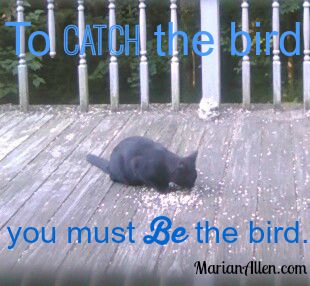
BE the Bird -- reblogged from MarianAllen.com

Well, not the bird, necessarily, but, you know, the whatever.

Say you're writing a story about a murderer. You know you have to put yourself in the place of the murderer: Why is killing acceptable/inevitable/enjoyable? What does it feel like to think about it, to plan it, to do it, to remember it?

But that's still pretty thin. Because a murderer isn't A Murderer. A murderer is Bill or Jolene. A murderer is an otherwise regular person who kills. Okay, yeah, possibly a wackadoo swivel-eyed loony, but probably just a regular person who does that thing. A murderer is somebody's child, spouse, employee/employer, co-worker. A murderer has a paper carrier, a mail carrier, a regular cashier at the grocery, neighbors. You're always hearing people who know murderers interviewed, saying, "Oh, he was so sweet!" or "I always felt like there was something wrong there." That's because a murderer has social interactions, bad hair days, kids they buy band candy from.

That's not to say all this needs to go into your story, but it needs to go into your head and heart -- in my opinion -- but some of that might impact how that character behaves that is in the story. It can make your character a real, rounded person, not a Murderer sock-puppet.

You can't just think, "What would it be like to kill?" You have to think, "What would it be like to be this person who kills?"

To be less grisly, it's the same for any character. What would it be like to be this person who falls in love? What would it be like to be this person who lives on this particular space station? What would it be like to be this person who gets a job teaching in this particular inner city school?
Catbird
Picture by Marian Allen -- actual cat actually on Mom's side porch actually eating actual bird seed
Sure, you can skirt around it by asking, "If I were in love / on a space station / teaching, what would I be like?" That's okay. That works. But that runs the risk of your making the character an idealization of the best of yourself and either eliminating or glossing over the flaws that make a character really interesting.

Much better to take some time to sit staring into space and getting into the zone -- the zone where you try to step into somebody else's skin, try to experience somebody else's emotions, think someone else's thoughts.

It's kind of creepy.

Nevertheless, the best books and stories and movies and television shows give you the kind of quirky, specific speech and action that make the stories and characters captivate you and stay with you for-like-EVver.

Marian Allen, Author Lady
Fantasies, mysteries, comedies, recipes