Showing posts with label desert. Show all posts

Monday, August 06, 2012

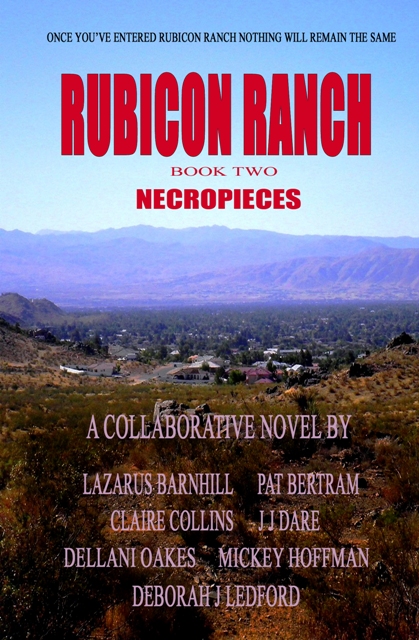
Rubicon Ranch: Necropieces -- The Story Continues

Rubicon Ranch is a collaborative and innovative crime series set in the desert community of Rubicon Ranch and is being written online by the authors of Second Wind Publishing. Seven authors, including me, are involved in the current story — Rubicon Ranch: Necropieces.

Residents of Rubicon Ranch are finding body parts scattered all over the desert. Who was the victim and why did someone want him so very dead? Everyone in this upscale housing development is hiding something. Everyone has an agenda.

Everyone’s life will be different after they have encountered the Rubicon. Rubicon Ranch, that is.

Although some of the characters were introduced in Rubicon Ranch: Riley’s Story, a previous collaboration, Rubicon Ranch: Necropieces is a stand-alone novel.

We hope you will enjoy seeing the story develop as we write it. Let the mystery begin! Whodunit? No one knows, not even the writers, and we won’t know until the very end!

Chapter 9: Melanie Gray
by Pat Bertram

Melanie locked the front door of the house and turned around to face the day. It was clear and warm with a platinum sun shining in an azure sky. She felt her spirits rise. With such lovely weather, things couldn’t be as bad as they seemed. She marched down the driveway, and her spirits plummeted as fast as they had risen. The sheriff’s tan Navigator, like a brooding predator, loomed in the driveway of the Sinclair house next door.

Melanie had tried to forget Sheriff Seth Bryan and the conflicted feelings he had aroused in her, but apparently she hadn’t succeeded. She could feel the emotions rushing back to fill the emptiness inside her. She still couldn’t tell if she’d felt more drawn to him or more repelled by him. With any luck, she’d never have to explore those feelings. As soon as he finished his business and left the area, she could forget him again.

She heard the sound of his voice, though not his words, and for a moment she considered dashing back into the house to avoid any encounter with him, but then she realized the truth. The sheriff had no interest in her. It had been almost three months since she’d last seen him, and in all that time, he had made no effort to contact her.

She lifted her chin. She didn’t need him or any man. They were all worthless creatures who had no regard for anyone but themselves.

Still, it wouldn’t hurt to see what he was up to.

She took a few steps forward so she could see the front door of the Sinclair house. The sheriff looked the same as he always had. Jeans and a white shirt with a badge on the shoulder clothed his lean, flat-bellied body, and a navy blue ball cap with a yellow “Sheriff” embroidered on it covered most of his dark brown hair. And he still wore those ridiculous mirrored sunglasses.

The sheriff and Moody seemed to be standing closer together than politeness dictated. Could something be going on between the two of them? Movement in the passenger seat of the Navigator caught her attention. Deputy Midget. If the sheriff intended anything shady, surely he wouldn’t bring a deputy along to witness his behavior? Then this must be an official visit.

Moody looked okay — happy, even. It had been very quiet the last week or so without “The Sounds of Silence” blaring at all hours, and she’d probably been enjoying herself in Morris’s absence.
The sheriff starting walking toward his vehicle. Melanie squatted to retie a shoelace, hoping he wouldn’t catch sight of her. She might have the courage not to seek refuge in the house, but she had nothing to say to him.

When she heard the sheriff’s Navigator slowly moving down the street, she squelched a pang of disappointment. As annoying as his attentions were, at least they had reminded her she was alive.
She’d been living with the dead — or rather memories of the dead—for way too long.

She arose with only the slight aid of one hand to push her erect, and angled her steps to the right of her driveway, intending to head up Delano Road to the desert. She paused, took two steps to the left.

The Daily Indecision is how she’d come to think of this inability to act. “Sounds like a newspaper,” she said aloud. “They’d print both sides of every story since the editor would be unable to decide which view to stand behind. Or maybe the paper would be blank because they’d never be able to decide which stories were newsworthy. And since when do you talk to yourself?”

Since Alexander died. She often wandered in the desert, trying to understand her husband’s death and her grief, and she’d gotten in the habit of talking aloud to him, hoping he could help make sense of her chaotic thoughts. He never responded. But then, he’d seldom replied even before he died.

When had their relationship become all about him? And why hadn’t she noticed the change? She sighed. Probably because she’d spent so much time online doing research for the coffee table books she and Alexander wrote. Well, she wrote. He took the photos. After his death, she discovered he’d somehow squandered the advance for the book about the Mojave Desert they’d contracted for, so now she needed to take the photographs in addition to writing the text. She thought she’d become good at shooting photos, but just this morning she’d received an email from her publisher:
“Some of your photos are usable, but most are uninspired. You take photographs, but the great photographers, like Alexander, make photographs. And when they make photographs, they make love. We feel the empathy between the external and internal events.”

Whatever that meant.

“What it means,” she said aloud, “is that you have work to do.” She took five resolute steps up Delano Road, then stopped. She could see Eloy Franklin hunched on his porch like a land-locked amphibian, watching everything that went on in his vicinity.

After all the turmoil the neighborhood had gone through recently, after all the deaths, she thought that things would have changed, but there Eloy sat, as unapproachable and forbidding as always. She’d smiled at him a couple of times when she passed in front of his house, but he’d never acknowledged her efforts at friendliness by so much as a nod.

Unable to stand the thought of Eloy’s scrutiny, she turned left. The sheriff’s navigator hadn’t gotten far, only a few houses away. The vehicle still moved slowly, as if the sheriff were looking for something. Trying to see the neighborhood through his eyes, Melanie peered down Delano Road. A petit woman held a camera to her face, either taking photographs or hiding behind it. Did Sheriff Bryan think the woman was Melanie? Melanie smiled to herself. Whatever faults the man might have, mistaking one woman for another was not one of them. Melanie had seen the woman several times before; she was shorter, prettier, and younger than Melanie, and had the clear luminous complexion of someone with a mixed race heritage.

Beyond the woman, a skinny man lurched along the side of the road. Melanie had also seen him several times before, and he worried her. Anger seemed to crackle around him, like lightning right before it strikes.

The Navigator’s siren blared, and the vehicle shot down the street and tore around the corner onto Tehachapi Road, heading east.

A dark cloud seemed to lift from the neighborhood, and Melanie’s indecision disappeared. She turned right, past Moody’s house, past the strange no-man’s land that separated the Sinclair land from the Franklin land, past Eloy’s house.

The wilderness beckoned.
* * *

Melanie stood at the crest of knoll and surveyed the expanse of desert. Somewhere out there, midst the creosote bushes and cacti, a photograph she could make waited for her — an image so compelling, viewers would immediately sense her empathy with the subject.

But how did one get emotionally connected to something as vast and as alien as the Mojave Desert? Then she remembered Alexander saying he looked for a significant detail. By focusing on a single feature, by making it the heart of the photo, the rest of the scene came into focus.

Crap. I’ll never get the hang of photography. Damn you, Alexander, for putting me through this.
She heard a sound closing in on her from behind, a leisurely whup . . . whup . . . whup. She turned and froze, transfixed by the raven gliding by. It flew so close she could see the brown pupil of its bright black eye and the purple and blue sheen of its feathers. She’d never seen such a huge bird—the body looked bigger than a cat, and its wings spanned at least three feet, maybe four. For a moment, it seemed to hang motionless, then a graceful wing beat stirred the air and propelled it forward.

Melanie fumbled with her camera, almost in tears. She’d had a perfect opportunity to make a photograph, but she’d become so lost in the moment, she’d forgotten all about taking a picture. Alexander wouldn’t have forgotten. His camera had been an extension of his hands, his eyes. He never let anything get between him and an image he wanted to capture. Not even Melanie. Especially not Melanie.

Then she heard it behind her again, the whup . . . whup of wing beats. And this time she held her camera ready. As the second raven passed her, she caught the image. Joy burst inside her.

I did it!

Only then did it strike her as odd that the two ravens had been so focused on their goal that they hadn’t seemed to notice how close they’d been to her.

The first raven had already disappeared, but she watched the second one descend behind a rocky outcrop thirty feet away.

She followed a barely perceptible track through the scrub to where six or seven ravens pecked at what looked to be the carcass of a small animal. A rabbit, maybe. Thinking how wonderfully the image of this raw savagery would contrast with the majesty of the flying raven photo, she crept closer. And gagged.

The ravens weren’t feeding on a rabbit, but something oddly familiar and totally out of place.
* * *

Melanie waited for Sheriff Bryan and Deputy Midget to pick their way up the rock-strewn path to the top of the hill. The sun glinted off the sheriff’s mirrored sunglasses, making him appear soulless.

When he drew near, Sheriff Bryan grunted. “I wish you’d stop finding bodies in such out of the way locations.”

“I didn’t find a body. I found . . .” She swept out a hand, showing the track and which direction he should travel.

The sheriff furrowed his brow at her, then followed the track. Deputy Midget trailed after him. Melanie brought up the rear.

Sheriff Bryan stopped by the outcropping. “A boot? You called me here to see crows playing with an old bloody boot? You must really be desperate to talk to me.”

“Desperate?” Melanie stared at him, the heat of anger flushing through her body. “Are you really so self-absorbed that you think I called you here on a pretext? I didn’t call you. I called dispatch and told them exactly what I found. It’s not a pretext, and they’re not crows. They are ravens.”

The sheriff and his deputy exchanged shrugs, then proceeded forward. The ravens squawked, rose as one, and circled above them, as if protecting their treasure.

Sheriff Bryan squatted, then whipped his head around, lips drawn back in a rictus, and faced Melanie. “A foot? That’s what you found, a foot?”

Midget took a step back. “It looks like something out of Morris Sinclair’s books.”

“Necropieces,” Bryan said, turning back to the foot.

“So where’s the body?” Midget asked.

“Maybe there isn’t one. Someone could have been illegally dumping medical waste.” Bryan rose and loomed over Melanie. “What do you know about this?”

She studied him for a moment, wondering what was going on behind those sunglasses. “Are you accusing me of something?”

The sheriff cocked his head like a raven getting ready to peck at its prey. “The person who calls in a report is always suspect.”

Tuesday, March 06, 2012

Introduction to "Grief: The Great Yearning"

Grief: The Great Yearning, the book about my first year of grief has finally been published. I wrote this article during the summer following my life mate/soul mate's death, long before I ever knew my writings about grief would be published, but with the addition of the last paragraph, it made the perfect introduction to the book. Grief: The Great Yearning is available from Amazon, Second Wind Publishing, and in various ebook formats from Smashwords.

-

Death came in the spring.

At the beginning of March, the doctors said that Jeff, my life mate—my soul mate—had inoperable kidney cancer and that he had six months to live. He had only three weeks. We’d spent thirty-four years together, and suddenly I was alone, unprepared, and totally devastated. I couldn’t even begin to comprehend the wreckage of my life. It wasn’t just he who died but “we.” There was no more “us,” no more shared plans and dreams and private jokes. There was only me.

Other losses compounded the misery. I had to sort through the accumulation of decades, dismantle what was left of our life, move from our home. We bereft are counseled not to make major changes during the first year after a significant loss—one’s thinking processes become muddled, leaving one prey to faulty logic and rash decisions—but I needed to go stay with my father for a while. Although he was doing well by himself, he was 93 years old, and it wasn’t wise for him to continue living alone.

I relocated from cool mountain climes to the heat of a southwestern community. Lost, heartbroken, awash in tears, I walked for hours every day beneath the cloudless sky, finding what comfort I could in the simple activity. During one such walk, I turned down an unfamiliar city street, and followed it . . . into the desert.

I was stunned to find myself in a vast wilderness of rocky knolls, creosote bushes, cacti, rabbits, lizards, and snakes. I’d been to the area several times during my mother’s last few months, but I’d spent little time outside. I hated the heat, the constant glare of the sun, the harsh winds. After Jeff died, however, that bleak weather, that bleak terrain seemed to mirror my inner landscape. Wandering in the desert, crying in the wilderness, I tried to find meaning in all that had happened. I didn’t find it, of course. How can there be meaning in the painful, horrific death of a 63-year-old man? I didn’t find myself, either. It was too soon for me to move on, to abandon my grief. I felt as if I’d be negating him and the life we led.

What I did find was the peace of the moment.

Children, most of whom know little of death and the horrors of life, live in the moment because they can—it’s all they have. The bereft, who know too much about death and the horrors of life, live in the moment because they must—it’s the only way they can survive.

During the first year after Jeff’s death, I lived as a child—moment to moment, embracing my grief, trying not to think about the future because such thoughts brought panic about growing old alone, trying not to think about the past because such thoughts reminded me of all I had lost.

And so went the seasons of my soul. The spring of death gave way to the summer of grief, and grief flowed into the fall and winter of renewal.

Grief: The Great Yearning is not a how-to but a how-done, a compilation of letters, blog posts, and journal entries I wrote while struggling to survive my first year of grief. As you journey through grief, I hope you will find comfort in knowing you are not alone. Whatever you feel, others have felt. Whatever seemingly crazy thing you do to bring yourself comfort, others have done. And, as impossible as it is to imagine now, you will survive.

***

Pat Bertram is also the author of Light Bringer, More Deaths Than One, A Spark of Heavenly Fire, and Daughter Am I. All Bertram’s books are available both in print and in ebook format. You can get them online at Second Wind Publishing, Amazon, B&N and Smashwords. At Smashwords, the books are available in all ebook formats including palm reading devices, and you can download the first 20-30% free!


Tuesday, January 10, 2012

Rubicon Ranch: A Collaborative Novel

I am involved in a wonderful project with eight other Second Wind authors. Rubicon Ranch is an ongoing collaborative novel that we are writing online. It is the story of people whose lives have been changed when a little girl's body was found in the wilderness near the desert community of Rubicon Ranch. Was her death an accident? Or . . . murder! But who would want to kill a child? Everyone in this upscale housing development is hiding something. Everyone has an agenda. Everyone’s life will be different after they have encountered the Rubicon. Rubicon Ranch, that is.

Each of us writers is responsible for the development of our own characters. My character is Melanie Gray. She has traveled the world with her husband, a world-renowned photographer. Together they authored many coffee-table books (she did the writing, he the photographs). One of the books told about mountains of the world, one about rivers, one about oceans, one about forests, and now they have a contract to do deserts. After they rented a house in Rubicon Ranch to begin their in-depth study of the southwestern deserts, he died in a car accident.

Now, not only does Melanie have to deal with the pain of losing her husband and figuring out what she’s going to do for the rest of her life, she needs to fulfill the publishing contract or she’ll have to reimburse the publishers, which she cannot do because the advance is all but spent. Since she is not a photographer, she roams the desert bordering on Rubicon Ranch, taking hundreds of photos, hoping that a few of them will accidentally end up being as brilliant as her husband’s photos always were. She finds the child’s body and takes photos of the scene after calling 911. At first she is a suspect but once the Sheriff has ruled her out, he requests her help in reading the desert and desert-related clues. Still, the sheriff does not trust her completely, thinking she is hiding something.

Chapter 26: Melanie Gray -- by Pat Bertram


Fury, like wildfire flashed through Melanie. Fury at the sheriff for paying his silly games when people were dead, fury at herself for playing his fool.

She’d been flattered that he thought she could help with his investigation, but apparently the only thing he’d been investigating was her and how to get in her panties. And she’d fallen for it. Cripes, what an idiot! All her resolve not to let him get to her had been for nothing.

And that whole seduction scene—”So maybe, when I need you to help me, I won’t have to bully you. You’ll cooperate with me because you understand that getting my job done honestly is the most important thing to me.” Did he believe his own drivel? And anyway, how could she help when he wasn’t doing anything? It had been two days since Riley died. Didn’t they say that if they didn’t catch a killer within the first forty-eight hours that chances are he or she would never be caught? And the sheriff had wasted those precious hours trying to seduce her.

She’d fallen for Alexander’s crap and apparently she hadn’t learned anything, because here she was again, playing straight-woman for another unprincipled clown. Alexander, at least, had offered her adventure and marriage, and for a while he had even been faithful. But Seth? What did he have to offer? Nothing. He was married, and he was a taker. He’d take everything she had, which wasn’t much, just her integrity, and she’d be damned before she let him tarnish that with a tawdry affair. She’d seen the look in his eyes when he’d said “And I know you’d rather claw out my eyes and slash my throat than let me touch you.” And that look had belied his words. He seemed to think all he had to do was pretend to know her and she’d fall into his oh, so understanding arms.

“What?” he said, sounding as if he didn’t know exactly what was going through her mind. How could he not? He, Sheriff Seth Bryan, the great detective.

“As if you don’t know.” Melanie spit the words from between clenched teeth.

Seth’s brows drew together in an almost believable though comic look of confusion. “That’s such a typical womanish remark. I thought you were different.”

“You thought I was gullible and naïve. You thought since I put up with Alexander’s philandering, I’d put up with yours, too, but that is not going to happen. Only a fool gets involved with a married man, and whatever you think, I am no fool.”

Seth held up his hands, palms toward her. “Whoa.”

“Being a widow does not make me ripe for the plucking. I don’t need to be serviced like a bitch in heat. Believe me, the last thing I need in my life is a man, especially a married man. Calling it separate maintenance does not make you any less married.”

He flashed his teeth. “So you do like me. You’re protesting too much.”

“Not protesting enough, apparently, or else you wouldn’t have that silly grin on your face.”

He lost the grin. “What’s going on here? I thought we were having a nice meal while we went over the case.”

“You should be going over the case with your deputies. They, at least, seem to understand how inappropriate it is for you to include me in your investigation. Unless I’m still a suspect and you’re trying to get me to let down my guard and confess?”

“I told you, you were never a suspect.”

“As if playing with me, gigging me as you called it, is any better. So let’s discuss the case. What were the results of the autopsy? Was Riley murdered or was it an accident? If she was murdered, how was it done and who did it? Were there drugs in her system? Have you interrogated her parents yet to find out what they’re hiding? Have you found out who the dead man is and what, if anything, he has to do with Riley’s murder? You pretty much ignored me when I said he looked liked Riley, but then, that’s understandable. I never got a good look at the girl. All I saw was her jaw line, her nose, and her eyebrows, so whatever I blurted out after seeing the man’s corpse has to be discounted. Did the same person kill both of them? Or were there two different killers? Or . . .” Melanie paused to grab the thought that flitted through her mind. “Did he kill Riley and someone else kill him?”

Seth picked up his sandwich, dipped an end in the au jus, bit off a piece, and chewed slowly.

Melanie nodded. “That’s what I thought. You’re all talk.” She deepened her voice and mimicked him. “‘We have to solve these murders.’ Yeah, like there really is a we. Well, there was a we, but that was Alexander and me. You and I will never be a we.” A cough shuddered through her torso. She took a long drink of water, hoping she wasn’t coming down with a cold but was merely dehydrated from the strong air-conditioning and her rare monologue.

Seth gave her a searching look, opened his mouth and then closed it again with what sounded like a resigned sigh. She wondered what he’d been going to say and why he thought better of it, then she let out a sigh of her own. It didn’t matter. She had enough to do with grieving and fulfilling her book contract. She had nothing left for the sheriff and his investigation. Whatever he might think, she really didn’t know anything. Well, that wasn’t strictly true. She did know one thing.

She threw her napkin on the table and stood, ready to flee.

Seth gaped at her. “What’s going on?”

“I’m going home, Sheriff Seth Bryan. I’m through with your games. You lied about investigating Alexander’s accident. I saw the photos in the newspaper and I visited the scene of the accident. There was nothing there to indicate that the crash had been anything other than an accident. Perhaps someone had tampered with the car, but the only way to find that out was to investigate the vehicle itself. And you didn’t care enough to check it out.”

***

An additional chapter of the book will be posted every Monday. Please join in the adventure — it should be fun! We don't even know whodunit and won’t know until the end. You can find the earlier chapters here: Rubicon Ranch

Friday, November 05, 2010

Vanquishing Villains

While walking in the desert today, I saw a dead rattlesnake. I hesitated to take a photo, not wanting to memorialize death, but it was so beautiful lying there, that I went ahead and snapped an image of it. Although it looked vibrant, as if it were sleeping, I could see that it had been run over. This made me think how even such a fearsome creature as that Mojave green rattler had enemies, though its four-wheeled killer was one it could not even imagine.

And so it is with a story’s villain.

For a hero to overcome her nemesis, she has to come at the villain from a different direction, not go at the villain from his position of strength. If the villain is the strongest person in the world, he cannot be vanquished by the second strongest person, but he can be vanquished by intelligence, perhaps even middling intelligence. If the villain is strong and smart, he can be vanquished by a determination to win at all costs. If the villain is smart, strong, and equally determined, he can be vanquished by esoteric knowledge, something the villain cannot even imagine.

My NaNoWriMo project has no villain. My poor character has to deal with her husband’s death, the loss of her home, the loss of her daughter’s respect. Since he had been the focus of her life, his death left her unfocused. Moreover, she finds out he is not who she thought he was, so to find out who she’s been all those years, she has to find out who he was. I’m wondering if her way out of this conundrum is to do or be something she’s never thought of before, something that until now has been unimaginable to her. Like what? I don’t know, but it will give me a direction to follow.

What about your characters? Do you have a hero/villain situation? What special strengths does your villain have? What special strengths does your hero have?

Wednesday, July 14, 2010

Zigzagging Plots

I walk in the desert, sometimes on straightaways, sometimes on hills. I learned something from the hill walks: she who goes up, must come down. And sometimes “down” means a very steep grade. I discovered that it was much easier to get to the bottom of these steep hills if I zigzagged from one edge of the path to the other. By descending diagonally, I can cut the steepness of the hill and am able keep my footing.

This seems to be a good metaphor for plot. While writing, we zigzag down an increasingly steep slope, never quite letting our readers know what direction they are traveling, but always keeping them on the path to the end. Or perhaps they are going up a hill, but the point is still the same: zigzagging.

I sent More Deaths Than One to hundreds of agents and editors, and the consensus was that my writing style was too matter-of-fact for the overly complicated plot. This from people who never read more than a few chapters. (Luckily for me, I finally found a publisher who read the whole novel and understood what I wanted to accomplish.)

It could be that as readers head down the steep slope of my story, zigzagging from side to side, the plot does seem complicated, but when they reach the end and look back, they can see that the story is very simple. A straight path. A man discovers that what he knows about himself is not true, and he sets out to discover the truth. Very simple. All the complications are simply the zigzagging path.

So, how do you keep your plot zigzagging? How do you know when to zig and when to zag? When readers look back from the finish line, can they see a simple story, or a complicated one?

Monday, July 12, 2010

A Walk in the Desert

My work in progress has a scene where the hero is escaping across a desert with a group of acquaintances, so as I take my daily walk I try to see what he would see, such as a ghost moon and a ghost sun. Unless he has sharp eyes, he might miss much of the color -- the flowers are so tiny it's hard to see them at a casual glance. There are few creatures, but he would see jackrabbits and ants, scorpions and snakes (though I have yet to see either -- whew!), and lots of lizards. The lizards move so fast that only when one stops to pose can I capture an image of it. Lucky for me, one did stop to pose.