Showing posts with label writing. Show all posts

Saturday, July 29, 2017

The Many Reasons For Keeping a Journal

I believe that everyone has a story. Some of the best ones I’ve read came from members of critique groups who were writing their life stories to pass along to their grandchildren. Those stories were filled with captivating details about times and places long gone. How did they do it? Aside from great memories, most of the writers kept journals. The ability to revisit times and places through old photos and the written word was invaluable.

I’ve kept a journal for most of my adult life. It began with boyfriend and school issues, then slowly progressed to work challenges, and later parenting ups and downs. Lately, I’ve discovered another reason to keep a journal. In fact, I’ve started a second one which has nothing to do with me as a writer, but as a daughter.

I call it the dementia journal. Our family saga began two and a half years ago, when my sister and I realized that our mother’s cognitive skills were diminishing. It seemed like a good idea to record what we were experiencing. I’ve since learned that journal records can give healthcare professionals better insight as to what’s happening.

Journals have many purposes, and not all of them are about writing fiction or memories. You don’t need to be a professional or even a passionate writer to note things down. But you can jot down a few lines about a memorable vacation or event. How about keeping a food journal filled with great recipes you’ve experimented with? What about writing down goals, or challenges to help you focus, or put things in perspective?

In his blog, Benjamin P. Hardy outlines several potential benefits when one starts to keep a journal. It’s never too late to start. 


Sunday, May 28, 2017

The Dreaded Back Cover Blurb: My Progress So Far

Members of my critique group have witnessed my struggle to write a compelling back cover blurb for my 5th Casey Holland mystery, Knock Knock. Soon, my editor will be working with it and chiming in. Anyone who’s attempted to write a back cover blurb knows how daunting this vital process is. Many readers make decisions on whether to buy a book or not based on that blurb.

So, it was timely to come across a how-to blog about writing a back cover blurb, and for different genres. For my genre, mystery and suspense, author Marilynn Byerly provides a four paragraph process, but she also provides tips for paring it down.

Essentially, she says that the back cover blurb should set up the plot and the protagonist’s emotional investment in the first paragraph. Paragraph two should elaborate on more plot set up and emotional involvement, or more information about the victim. The next two paragraphs focus on the stakes and the obstacles the protagonist must overcome. What is the interior conflict?

Here’s the tentative draft, version no. 342, or thereabouts. I lost count...

The latest attack in a string of violent Vancouver home invasions kills senior Elsie Englehart. Security officer Casey Holland is devastated. She’s let Elsie down. Casey’s supposed to be watching over elderly bus riders in an affluent, high-risk area.

Determined to keep others safe, Casey escorts an elderly man home one afternoon, but an armed intruder forces his way in and attacks them both. Hospitalized and frustrated, Casey struggles to regain control of her life, despite interference from family and colleagues.

Her fiancĂ© wants to postpone their wedding, and Casey’s boss cuts her out of the loop. Another violent home invasion compels Casey to take action, but at what cost to her health, her relationship, and her career?

Find out in Debra Purdy Kong’s fifth installment, Knock Knock, where the risks have never been higher, or the consequences more deadly.


I think it’s almost there. But I certainly welcome input. For those who want to read blurb suggestions for other genres, check out Marilynn’s suggestions HERE.


Sunday, April 30, 2017

Embracing Failure

I love collecting quotes, and one of my favorites comes from an excerpt in a Writers’ Digest Magazine article years ago. I’ve kept the quote pinned to my bulletin board for so long that the paper’s yellowed. Here’s what it says:

Rejection is a writer’s best friend. “If you are not failing regularly,” Gregg Levoy observes in ‘This Business of Writing’,” you are living so far below your potential that you’re failing anyway”.

This statement still hits me in the gut.

Over the years, I’ve tried to analyze and define what success and failure means to me in terms of my writing life. I’m still working on it. So far, my only definition of failure is to quit before my most important goals are achieved. Believe me, there are days when I’ve been tempted.

Last week, I read an interesting blog called “The 7 Differences Between Pros and Amateurs”. The one that jumped out at me is point #5, "Amateurs Fear Failure. Pros Crave It." The piece goes on to say that failure can teach you more than success ever will. When it comes to writing, publishing, and promoting, this is completely true.

I learned a long time ago that rejection or lousy reviews or poor sales is a part of many writers’ lives. But embracing those disappointments and learning from them is crucial. So this year, I’m planning to take more risks by asking for more reviews and guest blogging opportunities. I’m going to take more chances on new marketing and selling opportunities. Because if I don’t try, I’m failing anyway, and that’s not going to happen.

Here are more great quotes about failure:

“Feeling sorry for yourself, and your present condition is not only a waste of energy but the worst habit you could possibly have. – Dale Carnegie.

“Success represents the 1% of your work which results from the 99% that is called failure.” – Soichiro Honda

“Success is not built on success. It’s built on failure. It’s built on frustration. Sometimes it’s built on catastrophe.” – Sumner Redstone


Sunday, April 16, 2017

The Lazy Way to Publication

Over the years, I’ve been approached by a number of people who want me to write their story for them…and find a publisher, oh, and maybe an agent. The conversation always comes down to “You do it and we’ll split the royalties.” Honestly, I’m not sure I can hide the chagrin on my face anymore.

These people might have taken the occasional writing course or joined a critique group just long enough to sense how daunting writing a book can be, never mind selling and promoting it. Sometimes, the wannabe author is someone I’ve met socially, or while selling my books, or through a friend.

I call this the lazy way to getting published. Now, let’s be clear. I have nothing against someone wanting to hire a ghostwriter, and I often recommend reputable publishing services to others, but I would never take on the project myself. In fact, I’m highly suspicious of people who want to get from point A to Z without doing a shred of the leg work required, or who refuse to spend a single penny on a good editor, or writer, for that matter.

I’ve given workshops that outline the importance of having a social media presence, and offer simple how-to tips, only to have the occasional attendee say at the end, “I don’t really have to do all that, do I?” Of course not, provided they don’t want to sell any copies. My answer is a bit more diplomatic than that in person, but it amounts to the same thing. If you don’t invest in your idea without doing your homework and spending some dollars, then you won’t get far.

There’s a lot of nice people out there with great stories to tell, but it’s a slippery road to hell to commit your time and skill to someone who doesn’t understand what it takes to write, publish, and promote a book.


Sunday, January 22, 2017

How Many Books Can You Write In A Lifetime?

I’m not quite sure how it happened, but these days I’m overwhelmed with the reality that I’ve been juggling six different writing projects, including four novels and two novellas, for some time. Actually, one of them I haven’t worked on at all this year, but that needs to change.

There are different ways to look at this. One is that I’m a professional writer. I write, publish, and sell novels, and am paid through royalties and direct sales. For me, working on more than one book at a time is how I continue to be a professional. The other upside is that pretty much all of 2016 was spent writing new work, which isn’t something I can say every year. In hindsight, it was a pretty awesome experience.

But the downside? Well, given that I also have a 5-day-a-week part-time admin job, a mother with dementia who needs more attention, and a 2,500 sq. ft. home that requires cleaning now and then, it all becomes a bit much at times. On these short, dark, damp winter days, I feel my energy and my spirits wane, especially after one of my regular bouts of interrupted sleep.

After weighing the pros and cons, it comes down to two things: I still love writing, and I can choose to stop anytime. I created this life. I can also dismantle it. These are my choices, and on those overwhelming days I find myself wondering about the latter.

It was invigorating, therefore, to come across a blog this week on Quartz Media, about how Isaac Asimov, author of nearly 500 books, wrote so much, and yet struggled with some of the same issues that plague me. It was good to know that I’ve already been using some of his strategies, like working on several works in progress.

The piece of advice that resonates with me most is Beware the Resistance (part of this means being paralyzed by persistent insecurities about one’s writing). For me, editing a book to a satisfactory, publishable state is challenging. Maybe I should adopt one of Asimov’s other strategies, which is to not strive for perfectionism.


In Asimov’s world, taking on six writing projects is normal and necessary. So, maybe I’m on the right track after all. I just have to keep figuring out ways to play down the negative self-talk and stay focused on completing some of these projects. This year, the plan is to publish two books. We’ll see how it goes.


Sunday, November 13, 2016

Fear of Failure, Fear of Success

Ever tried to get over your fears? It’s pretty daunting, isn’t it? For writers, I think there’s plenty of things to worry about, and possibly fear, but I sometimes wonder if we project too much fear into our careers. Although we do invest a lot of time, money, and hopes into becoming published and/or making a bestsellers list, the fact is we’re not surgeons or cops or firefighters dealing with life or death situations. Sure, penning ideas to paper can have high stakes, but not on a daily basis.

Yet, many of us so passionately care about writing, being read, and earning money from our words, that the deep caring can be crippling. For me, I experience both fear of failure and fear of success to varying degrees. Most of the time, they’re well under control, but occasionally the feeling threatens to send me running. I start thinking about packing it in. But I then I remember why I’m really doing this—the love of writing—and then the boiling point relaxes to a simmer.

Doing a little bit of editing and/or writing each day works for me. Stamina and discipline are two things I have going for me. But a blog from John Athanasiou (HarperCollins UK), in which he lists the things that everyone in publishing needs to succeed, gave me pause to think. Although the article might be directed at employees of the publishing biz, I think a great deal of it applies to indie writers.

Some of the things on his list I’m already doing, such as creative problem-solving. Another great tip is called learning with agility. What he means by this is to not be afraid to fail frequently and fast, provided that you learn from your mistakes and move on.

Moving on quickly has been problematic for me. I stuck with the wrong agents for far too long, sought the wrong types of publishers, and attended the wrong types of conferences. I’m still learning to figure out how much time and energy to spend on social media, and to drop strategies that don’t work for me.

In case you were wondering the other three tips Athanasiou offers are:

. Power Communication and High Emotional Intelligence
. Openess, Integrity, and Honesty (openness is sometimes difficult for me)
. Results-Driven Work

He offers clear, concise explanations of each, so I strongly encourage you to visit his blog HERE. Meanwhile, time to get back to the results-driven work J


Sunday, October 02, 2016

Defeating Monster Fears and Relentless Self-Criticism

Let’s face it, negative self-talk can be a crippling experience for writers. I suspect that it’s an inevitable part of being human. I also suspect that the problem’s compounded when writers face internal or external pressure to write well and quickly in order to earn a living from their words. It’s a wonderful goal, but it’s often sabotaged by all kinds of thing, including ourselves.

Fear and self-criticism have been on my mind lately, as I grapple with my first foray into fantasy writing, a genre I love and read widely. I’ve outlined only up to a point and I’m now winging it, which is both exhilarating and scary.

While I work on the book every day, it’s only perhaps for forty minutes before heading out to the day job. I’m also trying to finish up other writing projects. The deeper I go with the fantasy, though, the more uncertainty I’m feeling. I’m nearly 200 pages into the story, and I’m beginning to forget what I wrote in the first 100 pages which is worrisome.

I find myself thinking that completing this novel to be publication-ready will difficult and take much longer than I thought. This isn’t helpful self-talk, but I’m working on more of a can-do, it will get done approach. The thing is, it all boils down to a fear of failure, right?

You’ll understand why I’ve been drawn to two blogs from writers who have thoughts about fear and self-criticism. The first is a short piece by ToddBrison who found freedom from fear through six words, nobody cares what you are doing. For him, this was a freeing experience that allowed him to get back to writing.

The second blog is by Maria Popova and is more of a dense essay, but an interesting one that discusses the important difference between critical thinking and critical complaint, which she also refers to merciless self-criticism. There’s plenty of food for thought in this piece.


I expect that writers will never banish self-criticism, and perhaps we shouldn’t, but the danger is in taking things to an irrational realm that destroys potential. I have no intention of letting that happen. I’d rather try and make mistakes—even big ones—then be too paralyzed by fear to try at all. As mentioned, though, paralysis lurks in my conscience these days. I can feel it waiting to strike, and that’s the monster I plan to defeat.


Sunday, May 08, 2016

My Guilty Pleasure

When writers talk about guilty pleasures, it usually involves chocolate, ice cream, alcohol, donuts, book purchases, or simply taking time off to have fun.

My guilty pleasure is much plainer. I watch TV. My husband does as well, so it’s our habit to emerge from our respective basement offices anywhere from eight-thirty to nine and watch two or three recorded shows. (Does anyone sit through commercials anymore?)

I know that writers are supposed to read and write a lot, and I do, but my creativity fades away after seven-thirty on most nights, and I save reading time for before bed. So, I was very happy to read a blog by Shaunta Grimes where she states if you want to be a writer, you should be watching TV.

Genre writers, especially those writing contemporary fiction need to have a handle on pop culture from one year to the next. Tapping into issues people are talking about is important.

Grimes is also quite right when she says that some of the best writing out there is happening on TV. Many of the stories are limited six or eight-part series. A entire season is only ten to thirteen episodes these days, which reflects the quick style of storytelling and diminishing attention spans that’s happened in North America. Watch the old Hawaii Five-O crime drama, then watch the new version and you’ll see what I mean. It’s certainly happening with books as well.

Watching great TV is like sitting in on a great writing class. I think about what I’ve seen, ask myself why I like it so much. What’s drawing me back every week and why? How is the plot being constructed? Which twists didn’t I see coming? Terrific characters, intriguing plots, tremendous conflict, superb buildup of suspense and tension, and the need to find out what will happen next are crucial ingredients to both viewers and readers.

In case you’re interested, here’s what hubby and I have been enjoying: Sons of Anarchy, Hell on Wheels, The Good Wife (one of the best written dramas I’ve seen in years), Madam Secretary, Banshee, Continuum, Haven, Penny Dreadful, Person of Interest, Rizzoli and Isles,. The Game of Thrones, The Blacklist, (some of the recent X-Files, although they could have done better). And, heavy sigh, I still miss Buffy the Vampire Slayer.

When we want a break from drama, we mix it up with sitcoms like The Big Bang Theory, Veep, and Silicon Valley. As far as “reality” TV goes, we watch Gold Rush, Yukon Gold, the Voice, So You Think You Can Dance, and hockey (or at least my son and I do). Honestly, non-dramas are guilty pleasures. The other programs are homework. So, find yourself some compelling TV shows, then study them. You’ll be amazed at how many storytelling techniques can be incorporated into your own work.


Sunday, April 17, 2016

Lovin' the Novella!

My publisher, Imajin Books, is launching a “Spring Shower Sale” from Apr. 17 – 23rd. Happily, my Evan Dunstan novella, DEAD MAN FLOATING is now on sale for $.99! This also seems like the perfect time to pay homage to novellas in general.

I have to say that some of the best stories I’ve ever read were shorter books, starting with the incredibly moving The Snow Goose by Paul Gallico. I loved this book in my early teens and I still love it today. More recently, I was completely captivated by Hugh Howey’s Wool.

As noted in a Publishers’ Weekly piece by Cynan Jones, many great stories weren’t full-length novels, including Breakfast at Tiffanys, Jekyll and Hyde, and The Great Gatsby. It’s interesting to note how many in Jones’ list wound up being movies.

As he also notes, writing a novel requires that every word counts. When it comes to novellas, reading isn’t a journey but an event with no room for digression. He also discusses the problem of labeling in the industry. Some publishers don’t want to tag a book as a novella, presumably because it won’t sell as well. Even Jones isn’t overly fond of the term novella, preferring to use “short novel”.

But here’s the thing, a good story is memorable, regardless of how it’s tagged and regardless of the length. The story will dictate how long it should be, and let’s forget about labeling. Novellas don’t require a huge time commitment for readers, and for this writer they are a heck of a lot of fun to write. I wouldn’t say they’re necessarily easier, though, as I’m currently working on the fifth draft of my second Evan Dunstan novella.

For those of you with busy lives who just don’t have time to read a 350 page novel, try a novella. In the writing world, shorter can be better and less is often more. Enjoy!

You can find DEAD MAN FLOATING ON SALE AT AMAZON:


Sunday, February 21, 2016

What's in YOUR Character's Wallet?

Or purse, or reticule, or pocket.

You know how the cops on cop shows go through the corpse’s pockets and find Clues? You can do that with your characters. Not just, you know, the dead ones. Or the undead ones, depending on what you write.

This is a great exercise, especially if you’ve been drinking are with a fellow writer who has read your stuff and whose stuff you’ve read; you can tell one another what you think is in the other’s characters’ wallets. You can challenge one another, like, “Okay, what’s in Heathcliff’s wallet?”

I mean, think about what’s in YOUR wallet. Better yet, go through your wallet and SEE what’s in there. Mine has credit card, debit card, driver’s license, rewards cards for hotels and stores, a picture of my mother when she was pregnant with me that was given to me by my husband’s oldest sister who was friends with her back then, the address and phone number of my pal Pat, postage stamps, photos of relatives, a picture of Dennis Kucinich, a photo of a mom and kid I don’t know but found discarded and felt sorry for….

In my purse, now, I have So. Many. Things.

If you’re stuck on a characterization or a plot point, try this exercise, and see if it shakes something loose. It might not bring up anything you want to use, but it might get those juices flowing again, or it might inspire a character twist or depth you hadn’t thought of before.

Marian Allen, Author Lady
Fantasies, mysteries, comedies, recipes

Sunday, October 11, 2015

Advice for Aspiring Writers

First, Happy Thanksgiving weekend to all of my Canadian friends and colleagues. I’m taking a break from hosting guest blogs this week to give pause and thanks for all the good things that have come my way.

As someone who constantly strives to improve my writing and promotion skills, I've read plenty of how-to books and articles over the past 35 years. I’ve also soaked up information at numerous conferences, workshops, seminars, and critique groups. I’m going to share some of the advice that resonates with me. Maybe they will for you too. 

First, stop competing with other writers. There will always be more talented or prolific, better connected, and luckier authors than you. Plenty of them will earn more money than you do, but none of this is important because their careers have nothing to do with yours. What really matters is your journey, that you make the most of your skills and opportunities.

Second, don't spend huge amounts of time worrying about failing. If you're inclined to fret, then worry about not trying hard enough or coming up with ways to work more efficiently and create publishable work. Rejection, lousy reviews, and poor sales months (even years) will happen. Most of those things are out of your control, so focus on what you can control.

There is no clear definition of what constitutes a successful author, so don’t let someone else do it for you. It’s a personal thing. A writer’s goals and ideas about success vary widely. It could be the number of books or short stories written, the number of contests won, number of books published, workshops given, great reviews, and income. Figure out your own definition.

Learn to work at a pace that suits your time, energy, and other responsibilities. Please don't fall into the "I must write multiple books a year to stay on top of Amazon's algorithm" trap. For the great majority of writers, it's unrealistic. If you're going to invest time to write a book, then invest more time to see that it’s edited properly. Great writing isn't a scribbling race, it’s a learning process.

I've heard more than one writer state that he/she is counting on writing income for their retirement. This is the world's worst retirement plan. Sure, we've all heard the stories about unknown writers rocketing to fame and fortune, but these incidents are still rare. You can hope for writing income to supplement your retirement plan, but to count on it is incredibly risky.  You've probably heard this many times before, but write because you love it, not for the money.

Lastly, publishing your novels can put you in the poor house. I’ve met many authors who've decided to go all out to promote their first book(s) by flying to conferences to take part in panel discussions, give workshops, and do book signings. Based on my experience and those of colleagues, it never pays for itself financially. In fact, you're lucky if your bar tab will be covered. You will enlarge your network and potentially gain more readers, but this will likely mean that you’re operating at a loss for at least several years, if not longer. Be prudent with your promotion spending and keep in mind that the big publishers aren’t likely to give you a promotion budget. In today’s world, there are plenty of free and low-cost marketing venues to promote yourself online.

Above all, follow your instincts. There will be conflicting advice from books, writing colleagues, agents, editors, critique groups, and well-meaning friends and family. At the end of the day, do what works for you and, above all, enjoy the journey. It’s your life, your words, and they should mean everything to you.


Sunday, July 12, 2015

My Year So Far

I had a birthday last week. It was a milestone year, but not quite the biggie that my friends suggested it would be. I chose not to make my birthday a biggie because I don’t want to change a single thing in my life right now. I have a part-time day job that I like, and I still get to write fiction, blogs, or book reviews every day. I’m currently teaching a writing workshop for the month of July and preparing for another talk on August 1st. Honestly, I’m not ready to retire, although my hubby are having these conversations more frequently lately, especially when we get together with friends of a similar age.

Still, given this milestone year and that we’re at the midway point of 2015, I decided to take stock and see how the year’s going so far. To be truthful, it was more challenging than I thought it would be, although not quite as tough as last year. Last year, I had a full-time job, wrote two blogs a week, edited my fourth Casey Holland mystery which was released in September, then submitted the 5th installment to my publisher. I also start writing novellas, attended several writing events, and sold books during the Christmas season. Granted, my day-job assignment ended in October, so Christmas selling season was less stressful than it could have been.

Having gone through a full-time job and a rigid writing schedule last year, I assumed that 2015 would be so much easier that I signed up for or accepted a number of different writing-related events this spring. Three of them were speaking events or workshops, all of which required a fair bit of research and preparation. Hubby and I also took a mini vacation out of town to attend a large, three-day craft fair. We travelled on Thursday as the fair started at 10:00 a.m. the next morning. In fact, the first day of the fair was eleven hours long! After the fair ended on Sunday at 4:00, we packed up quickly and made the five-hour drive back to Vancouver as both of us had to go to work the next day.

While the speaking and selling was going on, I finished editing my first mystery novella. I’m delighted to report that Dead Man Floating was accepted for publication by Imajin Books the day after I submitted it. We’ve been working on the final edits and I now find myself preparing my first virtual launch party in Sept. on Facebook. I’m finding that preparation for this event also requires a fair bit of work. There are guest blogs to arrange, tidbits to incorporate at the launch, reviewers to seek, and promotion to arrange.

It’s new, challenging, and exciting, which has been the theme of most of the events I’ve done so far this year. Speaking to a large group of people, or presenting a workshop is still out of my comfort zone, thus creating some stress, but when the day comes I enjoy myself and am always glad I did it.

I don’t think I’ve bitten off more than I can chew this year, although some days it feels like it. But as a professional writer who wants to continue growing a career, isn’t challenging oneself necessary? I’m devoting the rest of this year to embracing new challenges and learning and having fun. I’m sure there will be more moments of doubt and stress as my launch party approaches. But then I ask myself, how would I feel if I was too chicken to try?


Sunday, June 21, 2015

Using Your Senses. Or Not. --reblogged from MarianAllen.com

If you're a writer or if you've studied writing, I'm sure you've been told that using sensory details enhance the story.

I'm here to ask you to rein that in a little bit, hoss.

See, here's the thing: When I'm reading a story, I want to be in the moment. I want to experience what's going on along with the viewpoint character.

What that means is, I want to hear, taste, smell, touch, and see whatever the viewpoint character NOTICES, not what the viewpoint character hears, tastes, smells, touches, and sees.

Something that really jars me out of the moment is misplaced or meaningless sensory detail.

reason

I'm such a cheapskate. I want everything in a story to do more than one thing. If Anouk hears a mockingbird, I want there to be some reason she hears it. There might be mockingbirds mocking their brains out, but do we notice it? Usually not. We don't observe everything that's within our range of vision; if Billingsgate sees a Lexus, I want there to be a reason. If Action Man is in the middle of a knock-down, drag-out fight, the chances that he would notice the scent of frying tortillas is slim -- if he does notice it, it better have more impact than just the fact of it.

I also don't want the story to come to a dead stop to explain why Paula notices the texture of the tablecloth. If there's a reason, you won't be stopping the story; if you have to stop the story, there's no reason for that detail at that moment.

Now, none of this applies in a naturally sensory-rich setting. If somebody goes to the circus, it's perfectly legitimate for them to be all: popcorn, grit under my feet, lights and colors, taste of spun sugar, calliope music.

But not many of us walk out of the door in the morning and go: chirpy birds, this flower and that flower and this other flower, honeysuckle, my heels go click click click, peppermint toothpaste. If I'm going to be in the moment of somebody noticing all that, I want it to mean something, you know?

Like, okay: As Paula listened to Albert list the reasons he was leaving her, she ran her fingers over the tablecloth, morbidly aware of the warp and weft of the fabric, of the broken threads and imperfections left by years of use and laundering.

See?

If you're not writing from the viewpoint of a particular character, if you have an omniscient narrator, you have a little more wiggle room, but even there you need to choose wisely. You want to bring me into the setting, not juggle details for me. I hate being nibbled to death by ducks.

Marian Allen, Author Lady
Fantasies, mysteries, comedies, recipes

Tuesday, October 21, 2014

Blogging and Writing -- reblogged

I'm nothing if not thrifty. I posted this on the amwriting site, and reblogged it on my own blog, and now I'm sharing it here. I think it bears repeating.

Blogging and Writing

Blogging and writing -- As far as I'm concerned, that phrase is repetitive, redundant, and duplicates what are essentially two versions of the same word. And it does it twice.

Blogging IS writing.

Ah, but is it fiction writing?

Well, yes.

You see, I have a saying. Well, I have many sayings, including, "To hell with anything unrefined" and "Never give a sucker an even break or smarten up a chump", but the one appropriate to this post is, "Everything is about writing."

Which brings me to the questions writers who are thinking about blogging ask most often:
  • Wouldn't blogging take time away from my writing?
  • How often should I blog?
  • What would I blog about?
  • Who would care about anything I have to say?
I'll answer these one at a time.

Wouldn't blogging take time away from my writing?

See above. Blogging IS writing. Think of it as a writing exercise, and let it energize you.

How often should I blog?

How often do you want to blog? Some people say once a month, some say once a week, some say three times a week, some say many times a day. I blog once a day, every day. That's what feels good to me.

What would I blog about?

What interests you? What are you up to? What is your life like, as a person and as a writer? You can focus on one thing, like Medieval Weaponry or Macrame, or you can have certain days for certain subjects. I have writers and writing on Monday, food on Wednesday, and (writing) Sample Sunday. Some Sundays, I post excerpts from my books or stories; some Sundays, I post an entire short-short story or a poem. The other days, I write about tattoos I've seen, our pets, restaurants, things that irritate me, things that give me joy, books, movies, life in my small town or out in the country. You know -- the kinds of details that enrich the fabric of fiction.

People who live in the American Midwest find everyday details of life in, say, The Netherlands, exotic. People in The Netherlands find the American Midwest exotic -- or, at least, different. The general outline of your life, work, family, may be quite ordinary, but the details are specific. Nobody experiences life exactly the way you do, and it's that unique point of view that makes each person's fiction fresh and will make each person's blog fresh. Getting in touch with the specificity of your particular life is good training for creating a specificity for your characters and your settings.

Who would care about anything I have to say?

Say something and see.

Marian Allen, Author Lady
Fantasies, mysteries, comedies, recipes

Sunday, June 22, 2014

Exciting Possibilities

I’ve found that serendipity is often part of a writer’s life, whether it’s a chance meeting with someone who can provide that bit of information you’ve been seeking for a novel, or an introduction to someone who happens to be a great editor or jacket designer. This month, I had a number of conversations with writers, discussing their work, or their publishing and bookselling experiences. Each conversation gave me food for thought. Ideas for increasing my output and “discoverability” bounced around my brain, then faded away, and sometimes returned in snippets. But those ideas all gelled this weekend when I came across one of Dean Wesley Smith’s most recent blogs.

He’s been writing a series that he calls Killing the Top Ten Sacred Cows of Indie Publishing. This week’s topic was on the concept of falling behind, or missing one’s chance. The point that really struck me was to take a look at where I am now as a writer and ask myself if I still want to be in this same place five years from now. Smith stressed the importance of forming a business plan, and of achieving realistic goals that don’t set one up for failure. And so came my answer: create a business plan or, in my case, revise the plan I’ve been working on.

For many years, the plan was simply to learn how to write and revise a novel that would be publication ready. After that goal was finally accomplished, the second plan was to find a publisher while working on more short stories and novels. It was daunting, but I eventually achieved this goal. Since 2011, I’ve been publishing a book a year, something I could only dream about five years ago. But  over the past three years, I’ve realized that there’s another important step to take. I’d spent so much time revising my work that I didn’t realize I needed to revise my plan as well.

Thanks to those insightful conversations with others, I’ve come up with some ideas about how to make it happen. As mentioned above, the gist of it is about increasing my discoverability locally and on the Net. This does not mean joining more social media sites, but working smarter, particularly on short stories and novellas featuring novel characters I’ve already created. Ideas have already begun to flow. I’m jotting down notes and working on freeing up more time for writing. This is turning into an exciting year of possibilities.


Saturday, January 18, 2014

Guest Post: Essential Proofreading Tips by Nikolas Baron from Grammarly.com


Today's special guest is Nikolas Baron, from Grammarly.com, and he's sharing some great tips for writers on the importance of proofreading...

Proofreading, or line editing, is an essential skill set that every writer must acquire. Whether it be writing for a blog, a college essay or even a work related email, proofing your work is essential. Day in and day out, I spend my time studying people’s writing for my work at Grammarly.com, and it has become apparent to me that most people only afford the minimum amount of time to proofread their work. Granted, it’s been a few years since your last grammar class back in high school, but it is high time the writing world at large become expert proofreaders. Fear not ye intrepid scribes, for I am here to help you! As with most things, becoming an excellent proofreader just takes time and practice.

The first step is to set aside a proper allotment of time to work on proofreading your text. Proofreading takes concentration, which means turning off your cell phones, shutting off the television, and minimizing Reddit. I know it is painful, but you have to do it. All done? Great! Let’s get started.

Below are some easy-to-follow steps to help you on your way:
  1. Read slowly — perhaps the most important step to proofing is to read slowly and read out loud. Saying every word allows you to hear mistakes you might otherwise miss. 
  2. Correct one thing at a time — trying to correct every error in a paper can at times be a bit overwhelming. Instead, try to focus on one type of error. For example, it is easier to find and correct grammatical errors when you are only looking for grammatical errors. In summation, just take your time and be as thorough as possible. 
  3. Highlight punctuation — pro-tip here: highlight every punctuation mark. This forces you to study every mark and determine whether or not it is appropriate. 
  4. Read backwards — start from the very last word of the text. Reading backwards, word by word, is an effective technique to spot and fix spelling errors. It is also an excellent way to isolate sentences. Isolating sentences is an excellent way to give each sentence the attention it needs and expose errors you otherwise might have missed. 
  5. Ask for help — don’t be afraid! Proofreading is a difficult and often tedious process, so it is important to ask for help when you need it! It is never a bad idea either to have a second set of eyes check over your work. 
  6. Look it up — when in doubt, always look it up. You think this sentence needs an extra comma? Look it up. Is that word being used incorrectly? Look it up. Is this en-dash supposed to…yea, you got it. Look it up —a simple but effective practice. 
  7. Use online resources — fortunately enough, you live in the digital age, and that comes with some pretty lofty benefits. For one, there are a multitude of websites that specialize in proofreading. Sites like Purdue’s Online Writing Lab, for example, have a multitude of valuable resources wherein you could learn about grammar and different writing styles. Further, there are now a wide array of online proofreaders that can correct spelling and grammatical errors. One such site is Grammarly—an excellent proofing site that offers more than your average proofing site. Grammarly can even improve the quality of writing by offering input on style, detect plagiarized materials, improve diction and more. Undoubtedly, it is an excellent resource for any writer. 
By following these simple steps, you are already on the road to becoming an excellent proofreader. Just remember, becoming even an adequate proofreader takes time. But surely if you work hard, use every resource available, and learn from your mistakes, you will be a pro in no time.

By Nikolas Baron

Thursday, November 21, 2013

Writing A Novel, 250 Words At A Time

I'm doing NaNoWriMo this year. I did it in years past, "failed" it a couple of years, and didn't try at all last year. This year, I had the silly notion to use it to write something I've never done before: a Romance novel.

According to my impeccable reasoning, if I'm attempting something I have absolutely no practice in and no proven competence in, I have a license to fail. It's not only allowed to be of poor quality because it's NaNo, it nearly guaranteed to be of poor quality. How's that for taking off the pressure? It's like being dipped in Invulnerabilium or something.

So I'm having fun this year. And I'm keeping up with my word count.

Sometimes, it's hard. But you know what I do? Yes, the title of this post totally telegraphs the message: I tell myself I need to write 250 words. That's all, just 250 words. Sometimes that seems like a lot. Sometimes I do it one. word. at. a. time. But I seldom write just 250 words. Because the time comes when I count my words, and I have 276. If I have 276, I might as well try for 500. If I have 500, I might as well go for 1000. By that time, I'm nearly always on a roll, and I can exceed, hit, or come close to my word count.

I can't guarantee what I'll have when NaNo is over. It'll probably be an unusable mess.

But you know what? I don't really believe that. This is just too much fun to be a total loss.

Marian Allen
Fantasies, mysteries, comedies, recipes

Wednesday, September 25, 2013

How Do I Write? Let Me Count the Ways

Okay, I admit it: I am a closet pencilphile. Seems silly, I know, in this electronic age, but I write in pencil on loose-leaf paper. There. I’ve outed myself. I feel so much better now.

I am not being contrary. I do have reasons. I have a better mind/writing connection using pencil and paper than I have with a keyboard; a mechanical pencil is easier on my fingers than pen, and paper is easier on my eyes than a computer screen.

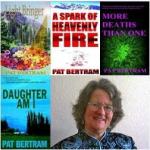
(The above photo is the handwritten copy of A Spark of Heavenly Fire.)

For me, fiction writing is largely a matter of thinking, of trying to see the situation, of figuring out the right word or phrase that puts me where I need to be so the words can flow. I can do this better in bed, clipboard propped against my knees or on a pillow than sitting at a desk. If, as Mel Gibson said, “A movie is like public dreaming,” then novels are like shared dreaming, and where better to dream than in a comfortable bed?

I don’t know the entire story before I writing, but I do know the beginning, the end, and some of the middle. That way I can have it both ways: planning the book and making room for surprises.

I need to know a bit about the hero, but most of the time I get to know the characters the same way a reader would — by the way the characters act. In my work-in-progress, I thought I had a mother who was manipulative, but a reader pointed out that if that’s what I wanted, I needed to show it better. I reread the sections with the mother and decided not to impose my will on her. Although she drove her son crazy, I saw her in the rereading as sad, as if she were trying to find a way to fit in the world or make it fit her, and that was much better for purposes of the story.

I need to write the story in the order it happens — it’s more satisfying for my logical mind and easier to keep track of — but if I get to a place where I know something happens without knowing what, I will skip it and go back later when I know what is missing.

So, there you have it. That’s how I write.

What about you? How do you write? Do you have a favorite place or a place that puts you in the proper frame of mind? Do you write from start to finish, or like Margaret Mitchell, do you start with the last chapter and work forward? Do you have to search for the words?

***

Pat Bertram is the author of the suspense novels Light Bringer, More Deaths Than One, A Spark of Heavenly Fire, andDaughter Am I. Bertram is also the author of Grief: The Great Yearning, “an exquisite book, wrenching to read, and at the same time full of profound truths.”

Thursday, August 29, 2013

New Opportunity for Literary Projects

Award-winning author, Deborah J Ledford has come up with an innovative way to finance her next project. IOF Productions Ltd. established the NatAmGoGo crowd funding campaign on Indiegogo to produce and distribute the audiobook version of her latest thriller novel, Crescendo from Second Wind Publishing.

The NatAmGoGo campaign will also benefit The Blue Feather Corporation, a Native American language and culture nonprofit organization.

The professional audiobook presentation will be narrated by TV and film actress Christina Cox, who has appeared in a variety of films and television episodes including NCIS, Dexter, 24, Castle, Chronicles of Riddick, Better Than Chocolate and Nikki & Nora. IOF Productions Ltd will record Crescendo in November at Costa Mesa Studios in Southern California for download and to purchase as CDs for a December 2013 release.

Crescendo“We are thrilled to have Christina Cox set to perform Crescendo. Her exquisite voice and acting prowess will truly bring my words to life,” Ledford says. “The audiobook will be recorded by an experienced staff, with the quality that will equal narrated books presented by top publishing houses.”

Contributor packages for the Indiegogo/ NatAmGoGo project include a PDF version of Staccato, the first book in the Steven Hawk/Inola Walela mystery series; autographed poster of the Crescendo audiobook cover signed by Christina Cox and Ledford; print versions of book series, including Staccato, Snare and Crescendo, signed and personalized by the author; a leather bound package containing all discs of the Crescendo audiobook with booklet signed by Cox and Ledford; a full content edit by Ledford of a manuscript up to 90,000 words, and hand-crafted jewelry created by a renowned Navajo, Hopi and Taos Pueblo artists.

Ledford spent her summers growing up in the Great Smoky Mountains of western North Carolina, where her novels are set. She met Floyd “Mountain Walking Cane” Gomez in 2006 while doing research for her award-winning novel, Snare. Several years later, Floyd expressed the need to protect languages and culture on reservations throughout the United States, which is why he is establishing the Blue Feather Corporation.

“The storytelling campaign is an effort to prevent the disappearance of Native American languages and culture,” says Arizona author Ledford, who is part Eastern Band Cherokee.

“Native tribal languages and ancient ways are dying on our nation’s reservations,” Ledford explains. “We want to ensure that ancient societies survive.”

The Native American nonprofit foundation will receive 50% of the royalties from downloads and sales of the Crescendo audiobook. “But once the funding goal is reached, any excess will benefit the foundation 100 percent,” Ledford adds. “We can’t let another language or culture disappear,” Ledford concludes. “‘Wado,’ which means ‘thank you’ in Cherokee.”

***

Click here to contribute: NatAmGoGo