Showing posts with label story. Show all posts

Sunday, August 07, 2016

Why This Writer is Watching the Olympics

I’ve never been an athletic person. It’s something I made peace with a long time ago, but I do admire any athlete who excels at their sport, whether they win a medal or not. It’s always inspiring to see jaw-dropping performances and the athletes’ elation as they achieve what they’ve spent most of their lives (and probably a great dealing of money) training for.

As a writer, the drama, tension, and anticipation of unfolding events reminds me of a great action novel, where I keep turning the page to see what happens next. These days, I’m switching the TV on day and night for the same reason. Can anything be more suspenseful than watching the best in the world prepare for the 100 meter race?

Can there be anything more devastating than to watch unexpected crashes and injuries during events? I’ve been watching the Olympics for over forty years and I still hold my breath every time I see a gymnast start their balance beam routine.

The Olympics is filled with compelling stories that intersect with one another throughout the games. It’s emotional, political, sociological, and in this Olympics, very much environmental.


Am I going to give up some writing time to watch? You bet. It’s the best reality TV out there, and I never could resist a good story.


Wednesday, September 25, 2013

How Do I Write? Let Me Count the Ways

Okay, I admit it: I am a closet pencilphile. Seems silly, I know, in this electronic age, but I write in pencil on loose-leaf paper. There. I’ve outed myself. I feel so much better now.

I am not being contrary. I do have reasons. I have a better mind/writing connection using pencil and paper than I have with a keyboard; a mechanical pencil is easier on my fingers than pen, and paper is easier on my eyes than a computer screen.

(The above photo is the handwritten copy of A Spark of Heavenly Fire.)

For me, fiction writing is largely a matter of thinking, of trying to see the situation, of figuring out the right word or phrase that puts me where I need to be so the words can flow. I can do this better in bed, clipboard propped against my knees or on a pillow than sitting at a desk. If, as Mel Gibson said, “A movie is like public dreaming,” then novels are like shared dreaming, and where better to dream than in a comfortable bed?

I don’t know the entire story before I writing, but I do know the beginning, the end, and some of the middle. That way I can have it both ways: planning the book and making room for surprises.

I need to know a bit about the hero, but most of the time I get to know the characters the same way a reader would — by the way the characters act. In my work-in-progress, I thought I had a mother who was manipulative, but a reader pointed out that if that’s what I wanted, I needed to show it better. I reread the sections with the mother and decided not to impose my will on her. Although she drove her son crazy, I saw her in the rereading as sad, as if she were trying to find a way to fit in the world or make it fit her, and that was much better for purposes of the story.

I need to write the story in the order it happens — it’s more satisfying for my logical mind and easier to keep track of — but if I get to a place where I know something happens without knowing what, I will skip it and go back later when I know what is missing.

So, there you have it. That’s how I write.

What about you? How do you write? Do you have a favorite place or a place that puts you in the proper frame of mind? Do you write from start to finish, or like Margaret Mitchell, do you start with the last chapter and work forward? Do you have to search for the words?

***
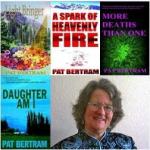
Pat Bertram is the author of the suspense novels Light Bringer, More Deaths Than One, A Spark of Heavenly Fire, andDaughter Am I. Bertram is also the author of Grief: The Great Yearning, “an exquisite book, wrenching to read, and at the same time full of profound truths.”

Monday, July 25, 2011

Whose Story Is It?

Every story is someone’s story. Whether we are writing about war, child abuse, romance, murder, or any other topic, we must make readers care about a character. Readers want someone to root for, to bond with, to love. Once they have found that, they will be eager to read further.

One of the hardest things for some of us writers is to decide whose story we are writing. We create a lot of characters while writing our novels, and we fall in love with all of them, even the villains. We feel disloyal to our creations if we give one character more consideration than others, and we believe the story needs all those points of view. Perhaps it does. But the reader doesn’t know that. All the reader knows is what is on the page, not what is in our minds, and all those equally significant characters become confusing. Readers need to know whose story it is. Or whose story it mostly is.

One way for us to decide this is to figure out which character has the most at stake, which one will change the most. If we are lucky, the two will be the same, and we will know whose story it is. If not, we have to make the character who will change the most into the main story character while upping that character’s stakes.

A character with nothing to lose is not one people will care about. If someone in the story parachutes out of a plane for fun, readers might find it entertaining, but they won’t be concerned. But if someone wearing a faulty parachute jumps out of a plane into flames to save a child lost in the middle of a forest fire, everyone except the most curmudgeonly will care.

The same is true of character growth. A character who remains static, who learns nothing from experience, is not someone readers can love. A story is always about change, and since a story is also about a character, that character should grow. A timid character could learn to stand up for himself. An arrogant character could learn a touch of humility. The essence of the character does not need to change. A timid reporter who turns into superman is the stuff of comic books, not a realistic novel. But a character who grows, who learns, who comes back from his or her experiences with something to share, that is a character readers care about.

And that’s whose story it is.

***

Pat Bertram is the author of Light Bringer, More Deaths Than One, A Spark of Heavenly Fire, and Daughter Am I.

Wednesday, June 29, 2011

R.U.E. -- Resist the Urge to Explain

There is a maxim in writing called R.U.E — Resist the Urge to Explain. Supposedly, if you show your readers the story rather than explaining it to them, it will allow readers to draw their own conclusions, thereby making readers a part of the story.

In some ways, my novel More Deaths Than One is a simple story. A man returns home after eighteen years in Southeast Asia to find the mother he buried before he left is dead again. Or rather, he finds her obituary in the morning newspaper, and when he goes to the cemetery, he sees a funeral party. He also sees someone who appears to be . . . himself. With the help of an unfulfilled and quirky waitress he meets in a coffee shop, he sets out to discover the truth.

Beneath that simple story lies the question of what makes us who we are. Is it our memories? Our experiences? Our natures?

And beneath that is the real story — a mythic tale of a man who reflects the people he meets back to themselves. This is the story I did not explain. I wanted readers to discover it for themselves, yet I’ve learned (by way of less-than-stellar reviews) that not everyone sees this story. One reviewer, who thought that the relationships were developed with too little explanation, couldn’t understand why the waitress would run off with someone she barely knew. I thought as readers got deeper into the story and noticed more of the characters seeing themselves in the hero (good guys saw good, evil guys saw evil, victims saw a fellow victim, the artistic saw the artist, the soulless saw a drone) that it would be apparent the waitress’s adventure-starved soul saw in him the fulfillment of her dreams. I guess not.

It’s too late to rewrite the story, and even if I could, I wouldn’t. But . . . here’s the question: should I have explained more? Should I have resisted the urge to resist the urge to explain?